Welcome to The Pauley Principle!

The Pauli Principle, named for Wolfgang Pauli, deals with atoms and electron-sharing that results in new, stronger bonds. Think 2 parts hydrogen and 1 part oxygen, a shared delectable (!) electron and VOILA! Water!

Similarly, when you prepare whole food to share with family and friends, especially foods you've grown, something amazing happens. Meals become tastier and healthier. Your soul, not just your stomach, becomes fulfilled. You live life more abundantly as a result. During a shared meal, the bonds that people create grow stronger and become something new: GREATER than the sum of the parts! I give you The Pauley Principle.

Friday, October 21, 2011

Wanted: A Newly Designed American Dream

Oregano


Tarragon
Sage


As I brought in my herbs in time to beat the first frost of fall, I was reminded of an earlier post about getting started on the road to being more self-reliant. I still believe growing tomatoes and herbs is a good place to start building toward a better future and defining a new American Dream.


   Our country is at a turning point. Each time we hit a turning point, the American Dream changes. My simple gardening approach is much more practical for most Americans than following books from the early 40's or mid-70's that touted having five acres and independence or becoming independent on an acre. In today's reality, buying and working an acre of tillable ground is out of reach for many and simply not practical. By contrast, herbs and tomatoes can be raised in pots on a patio and don't require much money. 

    The American Dream that sprang up in the 50's, in between the " back to the land" movements, resulted in the Smallvilles, Pleasantvilles, and even the literary Stepford. The public perception was manipulated so that "living off the land" was thought to be for poor but proud people, those who were willing to work hard just to keep food on the table. The boom times of the 50's in the U. S. had many people feeling rich, living rich, in comfortable little housing subdivisions. "Living off the land", in fact gardening itself, was no longer the thing to do. Ad execs did a fine job of painting the landscape. They showed land ownership as costly, inconvenient and undesirable for the American family. People were persuaded that, with their new leisure time, what the newly-planted American family needed was a 40-hour work week followed with activities such as ball games, bowling and family vacation spots to fill time and serve as diversions from agrarian life and crime. People were happy, and for a while crime was on the decline. Farming and food production, done largely by big corporations, was believed to be a more efficient way to feed the masses.
    
    At some point and for many Americans, the last train to the American Dream left the station unexpectedly, passing by many young people before they could even buy a ticket into Pleasantville or out of Fear or Hopelessness. For many, the only place left is Poverty, where people have little control. The ticket to Poverty is practically free, costing only a little self-respect. That's an extreme price to pay for both the individual and the country. That lack of control, that anger, leads to higher crime rates and drug use as means of getting by or coping with problems that poverty brings. The "lost generation" is those people in their 20's, the ones who are hurting the most, especially those who are un- or under- employed and have a college loan and/or health costs to pay off. No one should live in hunger or despair, and if this generation is allowed to slide under the train of dreams as it pulls out, our entire nation will suffer for it. 

    Number one in my attempt to make this a better world is to get people "back to the land", no matter how small their piece of the rock, whether rented, bought or shared with others. We gain balance as we work the soil, plant and nurture. And with that balance comes a sense of purpose.

    Since the unattainable American Dream of the past makes a lot of people very angry, and rightly so, the old paradigm needs to shift. What will the new dream look like? It's anyone's guess, but a new version, an adjusted and attainable American Dream that pairs Pleasantville with Farmville, should  be within reach. If we can just find and plant the magic bean, one that will bring jobs and needed productivity, then people can again work an honest, good-paying job to afford decent housing and good food. We need that magic bean as a way to help people get up on the platform for the next train, one that leads to a newly-designed American Dream.

Thursday, October 20, 2011

HI HO, HI HO, It's home from work we go!

Look closely and you'll see the chimney smoke wafting up into the sky while the rain makes a faint mist.


    Fantastic fall days reluctantly gave way to the wind and the raindrops that had been teasing at us, threatening us with a cold front. Even as I plan to work with Second Harvest food banks about the drastic effects Ohio's Issue 3 would have, Chris and I were pushed to get the last of our harvest in while I could still get into a dry garden and Chris could process our chickens in good weather. 
   
    The lawn isn't mowed. Flowerbeds aren't tended. Those things have had to wait while I gathered and processed the last of the garden veggies and Chris worked in a mad frenzy processing the last of our meat chickens. We both finished the same day, just after the rain began pouring down and the wind lifted the tarp that covered the chicken plucker.

    I didn't take time or have the inclination to get photos of the chicken processing out of my respect and reverence for the animals that are making such a huge contribution to our food supply. Processing chickens for food is not an easy thing to do, no matter how well designed the set-up is.

    Next year, I'm looking forward to eggs from our little Speckled Sussex hens. I also hope our fruits do better and with a little more attention, they should. And I would love to fish more!

    Chris and I work at it. Chris, all the time. Me, not so much anymore. Although this year was not good for our strawberries, apples or grapes, we've processed maple syrup, venison, chicken, corn, green beans, salsa, tomato sauce, whole tomatoes, pickles, and pumpkin. And we've laid by potatoes, zucchini, butternut, and acorn squash in winter storage. Admittedly, it's hard work, but it's not all for us. Almost every day we give someone some food. Not everyone can do this. We've been blessed. So now as I write, it's raining outside but it's cozy here with the warmth of the fireplace. Chris just came in from chopping wood and making sure it stays cozy.   

    My letter to the editor of our local paper regarding the unfair treatment and consequent shrinking of the middle class as it slides into poverty has just been published. I have spoken. I feel that, for now, for just this moment in time, with the canning and freezing equipment all cleaned and put away, supper in the oven, and the food laid by for winter, my work is done. Just for now.

    Tomorrow, I will speak again.

Wednesday, October 19, 2011

Pumpkin Puree, No Can Can

For preserving pumpkin, consider freezing, consider drying, but don't can.
    For days I calculated the number of pint jars I would need to put up pumpkin. Never had I seen our pumpkin patch produce like this!  Even after we had our fill of pumpkin blossoms (I love those things! Great little appetizers!), we still had dozens of pumpkins. Even after I gave away pumpkins to friends and relatives and then made pies, still I had a lot of pumpkins! So, with jars all gathered and lids enough to do them,  pumpkins gathered, I just happened to read a blog I like to follow, and  learned unexpectedly that the USDA does not recommend the canning of pumpkin puree, not even with a pressure canner. So, before I proceeded, I checked the Ball Blue Book guide to preserving. They have guidelines for drying and freezing, not canning.
    Then I looked up the USDA guidelines for preserving pumpkin.

 The USDA Extension Service in 1989 revised its canning recommendation for pumpkin, saying pumpkin puree is NOT a good candidate for canning since pumpkins have too much variation in thickness, acidity and water content to recommend a single process. 

I decided to puree and freeze my pumpkin pulp in 16 oz. vacuum packs, just right for a pie or pumpkin roll. If you are interested in cooking cubed pumpkin, 
the USDA says you can can that
but, cautiously, the current Ball Blue Book is not showing that method for home canning.

Monday, October 17, 2011

Blue Ridge Rendezvous


      Chris is ready to share the "pic-a-nic basket" which he offered in his best Yogi Bear voice.

    Chris and I had both been feeling the fatigue of the harvest. He had been processing poultry every chance he got while I had been processing vegetables. When we got the chance (our anniversary seemed a good excuse), we took off for the Blue Ridge Parkway to a northern section we had not yet seen. Trees were at their peak of beauty, weather stayed gorgeous, and we did a whirlwind two-day loop. 

    Near the end of our old Caddy's cruise on that segment of parkway, we headed up Narrow Passage Road off VA state route 43. That drive took us out to where some of the real people live. For all you bikers, I made a mental note that it looked like a great road trip for two wheels, offering plenty of twists, turns, and switchbacks through the mountains on surprisingly smooth pavement.

    We followed that winding route for several miles to Shiloh Drive and the Blue Ridge Winery where homegrown grapes had been turned into wine which evidently flows freely at their frequent parties. We had the opportunity to join the vineyard staff at one of their parties and taste their wines.

    The only bears I saw on this trip:


     Not only did they offer tastes of their wine but they also had a band that played songs of the 80's. The band helped set the tone of their barn party and benches, tables, and occasional haybales allowed plenty of seating for the crowd to enjoy the sights, sounds and smells all around. Smoke drifted into the open barn from a nearby BBQ stand. The food on site came right out of that smoking trailer and tasted so good. Pulled pork sandwiches topped with a sweet BBQ sauce and cole slaw~YUM!!!
 
Eugene, the purveyor of Smokehouse BBQ, had quite an operation going with plenty of hardwood smoke and a hopping business that gave people huge servings of delicious pulled pork or chicken for a most reasonable price.


Saturday, September 10, 2011

Short-term Exercise Program, Long-term Benefits

Gardening is a short-term exercise program that offers the promise of long-term edible benefits!


Admittedly, I got out of the hard work of gardening this year because of my broken leg. Chris really came through and tended the garden to keep the weeds out. The weather cooperated and voila!

Chris has recently been busy gathering the veggies. He brings them in and I wish I could say I take it from there, as usual, but Chris has also helped with food preservation. That is really quality time! Many of the beans and corn are already processed for later enjoyment. And others have been given away. Our potatoes, squashes and pumpkins soon need to be gathered and put in storage.

Now that I'm about to lose my walking cast, the work for me will get intensive. I'm gearing up for it with a daily workout program of Pilates and Yoga but I miss the aerobics of gardening and hiking!

Our family meals are largely Mediterranean-based and require plain tomato sauce, plain so that the sauce can be adapted for different purposes. Although we planted a wide variety of tomatoes, I'm especially pleased with the Romas this year. They're hanging in thick, heavy clusters that remind me of bananas. I'll start by first processing tomato sauce, then salsa and whole tomatoes. By the end of the season, close to frost,  the mix of stragglers will go into a blended tomato juice that can be added to other veggies for a little nutrition boost. Maybe making tomato juice will keep me from drinking the salsa!

I encourage all my readers at some point in your life to try making your own sauce and salsa. The fresh taste is amazing! And the health benefits are long-lasting! You don't need to pay money to join a health club!


Tuesday, September 6, 2011

Duckling

Chris really enjoyed this meal. Duckling! 
When I plated this for dinner, Chris said I had to get the picture. Here it is: duckling with brown and wild rice with orange-flavored cranberries, green beans fresh from the garden, served with a glass of cranberry-grape juice. A salad plate of cranberry sauce with orange slices
was already on the table.


Serving a meal of duckling seemed appropriate for Labor Day since the ducklings had been a labor of love from the very first moment of picking up the tiny yellow peeping fluffs at the post office to all their daily care, the heat lamps, the coddling. Then, when the Pekin ducks were beginning to get their white feathers, we moved them outside to the Hoop Coop, complete with its swimming pool and shaded area. By then, they were big enough and had their natural oils, necessary so that they wouldn't drown in the pool. The ducks have been a joy to watch, and we gave them the best life we possibly could. Chris worked really hard.

In a similar manner, my dad raised pigs on his hog farm. When I was a teenager, questioning the eating of meat, I asked how he could justify eating one. 
He simply said, "I give them the best life possible. The good Lord provides us meat, necessary for our bodies. When we eat meat, the animal becomes part of us, nourishing us, an ultimate 'thank you' for the nurturing care we give them." 

To kill and prepare what you've raised is humbling, like nothing else. My father had a reverence for all life, an attitude that is lost as we distance ourselves from the animal, the source of our meat, and go instead to the plastic-wrapped environment of a grocery store.

When Chris and I ate this meal, we knew that humble feeling, but we also experienced an adventure in both cooking and eating, and we soon realized this is a process we'll go through again. For Chris, it convinced him that we don't need to pasture steers for beef. He actually prefers the flavor and texture of duckling to beef! I enjoyed it too, very much! The meat is mild and tasty, like the dark meat of turkey that is properly prepared.

I have friends who wouldn't come see Pauley's Pampered Poultry because they knew we planned to eat the ducks eventually. Come on! Are we so far removed from the reality of our food that we can't accept that fact?!

Frankly, I don't want to take anything's life! I take a house spider out to the flower bed! But, in reality, my body dictates that I eat well and that means including meat, moderately, in the diet.

Thursday, September 1, 2011

Garden Give-aways and Possible Trades

In our record-breaking harvest this year, my gimpy leg has been a mixed blessing. Breaking a leg really slows down the ability to get into the gardens to gather the vegetables but it speeds up the willingness to share! Right now, as I write, I'm gathering up the energy to take this gimpy leg out to gather more green beans. As the garden grows over the next week, I'll probably find more green beans and sweetcorn than we can eat. For my viewers who are willing and able to pick, please give me a call or shoot me a comment. When possible, I love working out trades. It's such fun!

This year's harvest for us is not only abundant, it has been pretty much blemish-free. Chris and the little ladybugs have been out there doing their work while I leave them alone. (What can I say? He likes the little ladies and I'm reminded of the chicks.)

Remember my tomatoes that got out really late? Thank goodness! Even though we are now out of last year's canned salsa and tomato sauce, trying to hop up on the cabinet to hold down the tomato press while I crank away (yes, really!) would be quite a chore if I also had to watch my leg to keep it out of the way and painfree. The tomatoes will come, but by then I'll have full use of this gimpy leg! And then, again, I'll be back in business, making my salsa. Even canned, it tastes so fresh and yummy! Sometimes I just drink it!

Keep watching my post. The Roma tomatoes are coming on slow but plentiful, maybe more than I can crank out, and they are a very meaty tomato, great for sauce.


Tuesday, August 23, 2011

Squash Blossoms filled with Cheese

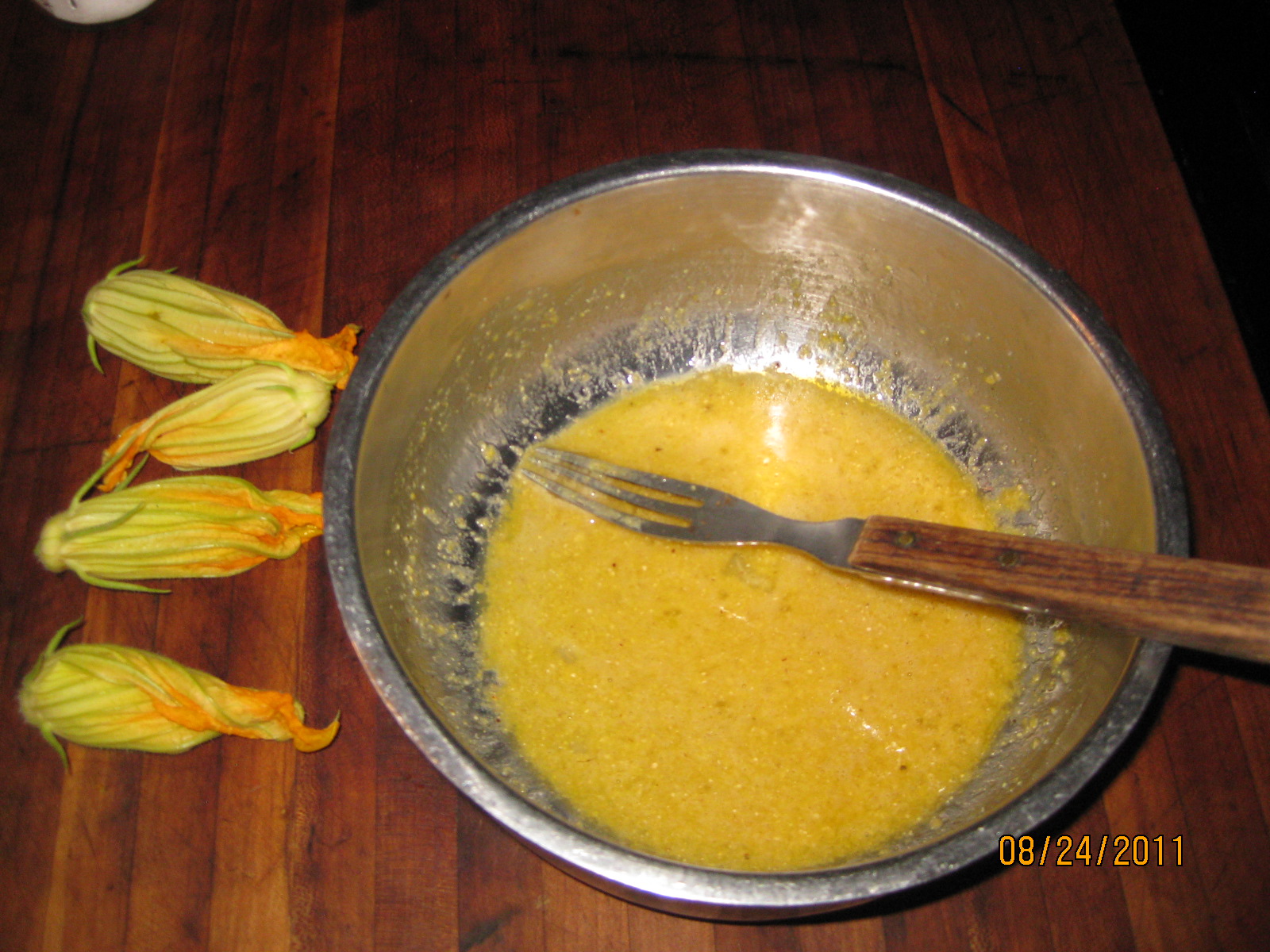
Pick fresh blossoms in the morning while the blossom is still open. Use pumpkin or large squash blossoms for stuffing. They're equally delicious. Today I used string cheese that I cut into chunks. Sometimes, instead, I use grated cheddar mixed with chopped jalapena and it's like a jalapena popper inside!

Stuff the blossom with cheese after making sure there is no insect busy working inside.Twist the open end so that it stays shut.  Dip in a simple batter made with 1 large egg, 2 tsp. cornmeal and a dash of salt.

Saute on each side just until golden in olive oil and butter, or your favorite oil.

Stuffed squash blossoms make a great appetizer or healthy after-school treat. Serve warm. The first thing you notice is the tasty crunch and then your tongue finds the cheesy deliciousness inside the delicate blossom. It's so good! 100% pure YUM!!!
"Plant a zucchini and feed the world!" my husband used to proclaim. Not anymore. Now he realizes the potential in the beautiful blossoms as a summertime treat.

Tuesday, August 16, 2011

If You're Gonna Raise Pole Beans, You've Gotta be Real Tall

From front to back: Early Girl Tomatoes, Blue Lake Pole Beans, and Gotta Have It Bi-color Sweetcorn.
For the first time, we tried growing pole beans. Pictured are Blue Lake pole beans but we also have Kentucky Wonders. Up until now, my favorite beans were Blue Lake bush beans, a little different critter than the ones that shinny up a pole. Even with the boost of my walking cast, I cannot begin to touch the top of the poles. How will I ever pick these beans?!

Well, I have an idea.  A couple of weeks ago, I broke my leg, the lower fibula. After that, I tried walking with crutches but Chris soon witnessed a first-rate pole-vaulting event when I flew over the front walk and into the bushes. So I'm thinking maybe I can try that same technique, make a fast hobble for it, get a little more height next time, and reach the beans to pick them on my way down the other side.

Frankly, it's the best garden we've ever grown and it just may have something to do with my staying out of it these past two weeks. Those days are over. Our daughter wanted to come home to help with the harvest and, when she visited, I soon discovered what she meant. She loaded up her car with fresh produce to take back! That's all! So I ventured out this morning, walker in tow, steadied myself, and picked some bush beans for my own table! After all that effort, they're gonna taste so good! I know, it would have made a better story to say I pole vaulted to pick them. Maybe next time. Those pole beans aren't even blooming yet!

Saturday, July 23, 2011

Heirloom Chicks


These Speckled Sussex chicks love being on the grass. At night they still sleep in their brooder but by day they enjoy the fresh greens, insects and sunshine that they can only get in the great outdoors.  

In order to keep out predators, Chris has their run secured with two different sizes of wire mesh. Outside that is an electric fence so that Pauley's Pampered Poultry remains safe and secure.  

Then, before long, they'll be ready to move into the Chicken Condo where they will have even more room and a larger outside run. The free range chickens will continue to be secure from predators, the greatest threat to their health. 

Known for being an heirloom breed, the Speckled Sussex numbers are limited. That may change as people begin to recognize their ability to withstand heat and pathogens, something newer hybrids don't handle so well.

Making egg-laying pets of these little chicks should be fun. Varied markings and already distinctive, but friendly, personalities will make it easier to name them. They're fun little chicks.   Maybe we'll decide to raise a brood hen so that we can raise and perhaps sell more of these delightful little cuties!
(If our suspicions prove true, 
there's one daring little rooster in among the fifty little hen-chicks!)

Tuesday, July 12, 2011

Vitis Grapes!

Just as the season for planting was coming to an end, WOW! A surprising find! After searching locally, online and in catalogs, and after asking several people, Chris finally found our vitis grapes, supposedly good for our soil type and climate. This variety is the Edelweiss grape, yellow-green when ripe, a mild, sweet grape.


Vitis grapes are specially cultivated for wine. The flavor they hold depends heavily on the soil the grapes are grown in as well as climate and rainfall. Since rainfall is an uncontrolled variable, harvests will be different from year to year. Another experiment in winemaking!


In 90 degree heat, Chris prepared the new bed for planting and added a 40-foot arbor to the vineyard. Then, to beat the oncoming storm, he planted at night by truck light. Funny, he enjoys a good glass of wine about once or twice a week. Grapevines require months of growing in good conditions then harvesting at just the right time for winemaking, which adds a few more months. This is a fine example of delayed gratification. All gardening and farming is! If it all falls into place, we hope to share a bottle with friends and family--in about a year--and then I think Chris will feel that it was worth the hard work! Hmmm!

Sunday, July 10, 2011

The Mystery Beans


This jar stayed in the basement for only God knows how long. Mystery Beans is what I called them. They had belonged to Chris's dad, so I knew they were his seed crop. They had to be good. We'd heard of seeds from a pyramid that still germinated and these seeds weren't THAT old so we gave them a try in our garden. Then I scouted out similar seeds at bulk seed suppliers and was able to identify them as the Kentucky Wonders, a pole bean! OOPS!  We planted them wrong. 

Just to be sure they were worth the extra work, I made venison chili using some beans from the mystery jar. YUM! They ARE worth the effort! Full of flavor, they're similar to a kidney bean and produce their own rich brown broth.

We were already experimenting this year with Bush's Blue Lake Pole Beans. Since we'd never grown pole beans before, Chris, being the resourceful person he is, supplied our garden with poles by thinning out the young maple sapplings from our maple grove. If nothing else, it brings back the nostalgia of our trips south and the way things used to be done. Especially, it brought back memories of his dad's huge garden. Sure, it's going to be more work but, without this extra work, it's hard to experience the goodness of the flavors and textures of the way it was, of times gone by.


Bean Poles ready for Action  

Saturday, July 2, 2011

The Water Hydrant


An ancient dug well has been our water supply for the pampered poultry. After the ducks discovered their wading pools, packing water became a time-consuming chore! Now, with baby chicks in the brooder, Chris did the necessary thing. He spent a large portion of one day installing a water hydrant near the chicken condo (still in progress). 


Life is good for the Pampered Poultry
There's always something to do if you're trying to raise much of your own food.  Since Chris isn't running back and forth to the well, he has more time for gardening. He'll be glad to have the hydrant for that too!

Thursday, June 30, 2011

52 Hot Chicks on the Run! The Speckled Sussex babies have arrived.

The USPS does a great job of transporting chicks. An early morning phone call lets you know the chicks are at the Post Office and we can either pick them up or they'll deliver by truck. In no time at all, Chris was on the road to pick up his chicks. These hot chicks were shipped out the day they hatched. That's quick. 


Since the little chicks are naturally warm and have to stay that way, their brooder has to be kept in the 90's during the early days of their lives. The brooder stood waiting and ready.

The first thing Chris noted when he took the 52 little Speckled Sussex chicks out of their mailing box is that they could RUN! They seem to actually prefer running. Whether they're on their way to food, water, or to chase a fly, they run.

What makes it even more fun is that the chicks will also run to us! They actually seem friendly! 
And Chris is determined to keep them friendly.

The chicks are in a climate controlled brooder. After the brooder, they might get to live in the hoop coop since the weather will be suitably warm. Then it will still be several months before these chicks will produce eggs. After a few weeks in the hoop coop, as fall nears, they'll move into the chicken condo where they will still have the opportunity to get out in the yard for some real foraging. This is going to be FUN! What's fun that isn't also a little work? And we're hoping to enjoy having them  for many years Besides, what other pet do you know that can lay an egg?

Wednesday, June 15, 2011

The Haystack

Chris is tossing the hay up into the haymow.

He has some great ideas for using the hay!

Whatever he's thinking, at least he's motivated to get this job done in a hurry!

This was just the first of three trailer loads! He says it will fit and he should know. He built this barn!
Making hay the old-fashioned way! When you've just got a small field and a little time to spare, it could be the green thing to do! Note, however, the absence of horses and a hay wagon. Admittedly, it's not the perfect shade of green but definitely gave a great workout for all involved!

Monday, June 6, 2011

Hoop Coop

Chris completed his 10' X 20' Hoop Coop (that's what he's calling it) just in time for the ducklings' 3-week birthday.

The ducklings wasted no time trying to learn all about their new residence. Just wait til the wading pool comes!

Tarps and chicken wire over cattle panels should ward off predators but, just in case, the Hoop Coop is surrounded by electric fence. The potato patch is in the foreground.

They're looking cozy! Earlier today, when Chris caught them, they must have thought they'd met their end. He picked them up just like you should, petted them and tried to calm them but they weren't happy about it. Now they have fresh air and natural ventilation, both sunshine and shade, and all the grass, bugs, feed, grit and water they could want.
If it has to be a short life, at least it can be comfy!
(To the ducklings: Happy 3 Week Birthday!  :)  Enjoy the Hoop Coop!)


Sunday, June 5, 2011

Making the Salsa Bed

Chris hated breaking his last night's promise to plow the backyard garden today. He was planning to use his Gravely. It's an antique, I think, but this would be our first experience with it for the garden so we were both excited to see how it did. Last night's 9/10" rained spoiled our plans and Chris was back on the farm instead with the Gravely doing some sickle bar mowing around the pine trees instead.

So, without any kids, without any visitors, and without the Gravely, that left me to try to find a way to get my vegetable seedlings into the ground--finally! I'd already wasted my first batch of tomato sprouts since I started them in February, afraid I'd run out of salsa before I had more tomatoes! Pretty foolish, I know! But now I had seedlings that weren't growing well because they needed outside in rich garden soil, rain and real sunshine. The first thing I did was to take inventory of the cold frame where my mix of lettuces and kale had been. There were a few stragglers, so I pulled them out, washed them up in the kitchen and allowed them to drain while I yanked out the weeds that had overtaken their space. 
All afternoon I worked, yanking weeds and preparing the soil for the new arrivals. I planted in the rain so no need to water further, I figured. I was a happy gardener, not really knowing how to go about crowding my veggies. I decided to do it a little like raised bed gardening since the veggies would have to be in there tight. The first thing that went in were the sweet potatoes. I had to have a place for them since the voles at the potato patch were horrible little monsters! They would eat them up underground and we wouldn't have a clue until harvest time. (But aha! We have now erected a raptor perch, hoping to attract hawks to find the voles since voles also eat pine roots, but I digress. The pines are a totally different topic.) Back to my gardening:

 In the very back I have yams and sweet potatoes. This frame has eight inches of topsoil and sand above the ground, so I suppose the potatoes will have room to burrow. In front of that are six yellow tomato plants. In the very front I have planted my ten little mixed pepper plants. I will dub this bed my "salsa bed".


One surprise: In with my pepper seedlings was one lonely unidentified tomato that I mistakenly labeled and treated like a pepper. So I potted it and it will become someone's mystery tomato patio plant.

Saturday, June 4, 2011

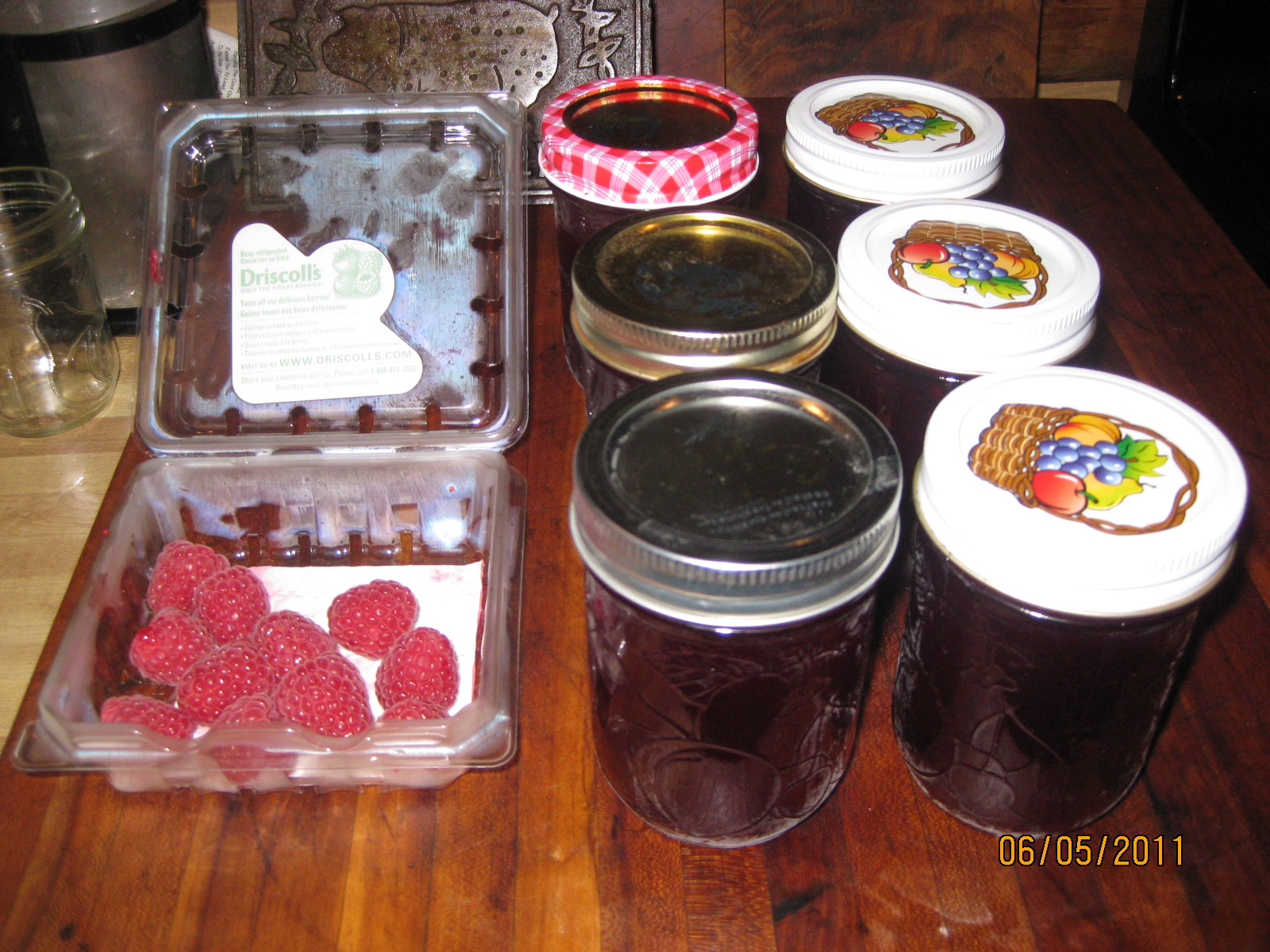
Raspberry Jelly!

I have three young red raspberry vines in the berry patch. No way could they produce the two quarts needed for one small batch of jelly, so when I saw fresh California raspberries at a great price, I gritted my teeth  and latched onto enough to do it! It didn't matter that I had enough chores lined up that I couldn't see an end in sight.  I would find the time to make red raspberry jelly!

One tip, fresh from the pectin package directions: Hold back a few berries if you want a thicker jelly. I was going to anyway just because, well, they're fresh berries!  :)  I'll still watch the farmers' markets for the local berries unless my little berry patch produces a humongous amount of berries this year!

Making jelly takes a little longer than making jam but the result is a smooth spread with no annoying seeds to get stuck in your teeth. On the other hand, jams and preserves give you the pulpy sensation of fresh berries. I like them all but if you want a smooth spread, you may want to plan for the additional items needed and the time involved. The result is worth it. 
So I gathered all my tools together before I started cleaning the berries. This time I decided to use my trusty tomato presser from last year's tomato processing. This little handcrank machine (top pic on the left) would remove seeds of the raspberries instead of my mashing them by hand as the directions said or using a food mill. Using this presser is a workout and it's a little awkward to put together, but it's effective. This step cuts down the time needed to strain the clear, fragrant juice that will turn into jelly. Then, once you start cooking, it goes so fast! Have the jars ready!  Two quarts of red raspberries should produce six cups of jelly.

Wednesday, June 1, 2011

LIFE IS DUCKY!!!

Just for fun, I gave them a little waterer inside a feedpan! They splashed the water out and for a few minutes there was a pool party! Just wait til they get their wading pool!

Water cooler gossip! You can tell something's on their minds. Look at the way they're avoiding my eyes. 

Hard to imagine these lanky birds are just fourteen days old. They're starting to grow tail feathers.

The Potato Patch

The leaves of these potatoes are looking really healthy, no bugs in sight!

Growing Potatoes

Over the past three years we have tried our best to be green with growing potatoes, attacking the dreaded potato beetle with our bare hands. Chris would get out and hand pick the bugs from the potatoes, not wanting to kill the praying mantis babies that we hoped would get the job done. Sometimes he would pick potato beetles for an hour, counting and one day catching more than 600 bugs over several hours, only to see more coming onto the plants later that evening. A single bug can easily destroy a plant in a day, so imagine what just a hundred could do!

One of the problems with potato beetles is that the larva is underground where you may not notice them until they emerge from the ground as fully developed bugs with voracious appetites. Our solution? Imidocloprid, sold as Nuprid. Treating the soil seems to be effective, halting the development of the larva in the early spring, prior to planting potatoes. The potato crop is coming along really well without the lacy leaves associated with bug damage.

We'd rather be green about our veggies, so if anyone has a practical solution for potato beetles, please pass it on! I hear ducks eat them and we have some ducks that go into a feeding frenzy when they see a cricket so what would they do in an infested potato patch? I have to wonder!

Monday, May 30, 2011

The Chicken Condo, in Progress

Measuring 18' X 36', this unit is big enough to house a small family. Instead, it will be a four-room building for housing different kinds of poultry. Little chicks that will become laying hens will be the first inhabitants. The plan includes nesting boxes, a roost, little chicken-sized doors, and a large run outside when the notion hits them. (No, the ducks won't live there. Chris is designing a kind of movable playpen for them that will include a wading pool.)

When this chicken house is finished, most of its inhabitants will be chickens we plan to raise for meat. The process is designed to give them comfortable and healthy living conditions and we plan to do this for several years.

There has been quite a bit of interest as people pass by the farm. Some stop to inquire. We're finding out several people, whether city dwellers or country dwellers, are interested in poultry. Some want a few laying hens in the new "urban farm design". Some want to duplicate what we're doing but on a smaller scale, and some want to enjoy the produce from ours. Occasionally, people take pictures of it. One new friend said he wanted to use some of the design ideas Chris has in the chicken condo for his family home but I'm not sure whether it's the piers he likes or the steel supports for the floor. Maybe it's the ample lighting, complete with skylights. See why I call it the Chicken Condo? By the way, a friend called it that, just in passing, and it stuck.

Whatever the reason, the chicken condo has attracted some attention. Some people are still wondering if it will be for rent soon. If our plan to supplement our groceries with good and good-for-you home-grown produce doesn't work out, it just might!

Wednesday, May 25, 2011

Good Day for Ducks!

The weather, being what it is, will likely do what she wants to do. Is it a good day for ducks? I asked Chris. His fact du jour was that the ducklings need to stay in their brooder and out of the rain. To allow them to swim in a pool of water could be fatal. The reason: Since Chris became their surrogate mother, they don't have the advantage of their mother's natural oil that penetrates feathers and keeps ducklings afloat on water. Besides, their brooder provides the ducklings a clean, controlled environment with steady temperatures and protection from predators.

It's working. All eleven ducks are healthy and active and, when I visit, they give me a cocked-head sideways look that only ducks can do, like they're thinking I don't know what you are or why you're even here, but I think it's time for you to leave!

Right now Chris is making a movable "schooner" so that when the ducklings can get outside, there won't be a chance for a predator to break through. He's already built a fence, electric and woven wire combined, to keep out the big critters. The ducklings will live inside this schooner that will keep out everything but sunshine, insects and small birds. Chris will move the schooner around the poultry yard from time to time to give the ducks fresh grazing. By the time they get outside, the ducklings should be ready for their wading pool.

All this for table fare? You're right, and here's why. We want to raise a portion of the meat we consume and give the animals a good life. Suppose a person eats 8 oz. of meat a day. The cost of getting started with poultry is a one-time expense, except for maintenance, and with little continued overhead. The cost of producing poultry is considerably less than beef because their weight gain is so rapid!  Raising ducks requires less land than raising a steer, much less time to reach maturity, less feed per pound of weight gain, and we like the meat. So it's a good choice for us. Improved quality of life=improved meat. On top of that, the environmental footprint is greener than it would be with beef.

Is it a good day for ducks? Yes, if you're in an environment that takes care of your every need!!! That's what we're doing! And we'll keep on doing it to the end of their days!

It's all good except for one little problem: I still haven't found the white vintner grapes that I can grow in this locale that would make a really delicious and smooth wine to serve with duck.