 |
| Our beautiful Speckled Sussex rooster is beginning to turn aggressive. He has 48 chickens to protect and he's taking his job way too seriously. Early on, in order for Roosti-Roo not to think Chris was another rooster, Chris would toss him a little food when he entered their range, knowing that the rooster should not see him as a great big competitive rooster since no other self-respecting rooster would show up with feed! The plan seemed to work for a little while until we began to see hawks in the area. Now, he's totally aggressive and seems to think maybe Chris is a giant hawk who dropped its prey in the pasture while he plans a terrible attack on unsuspecting hens. Who knows how a rooster thinks?! |
Showing posts with label poultry. Show all posts
Showing posts with label poultry. Show all posts
Monday, February 6, 2012
BEAUTIFUL ROOSTER GOES MEAN


Tuesday, January 24, 2012
Build your Own Egg Washer--The Egg Jacuzzi!
 |
| Egg Jacuzzi |
Chris built his Egg Jacuzzi along the basic design of the Incredible Eggwasher that sells for about $116. The Egg Jacuzzi is incredibly simple and inexpensive to make, and you can save a bundle by building one yourself.
Step by step instructions follow along with a brief video.
 |
| The end result is sparkling clean, sanitized eggs. |
 |
| You need a five-gallon food safe bucket. |


1. Start with a food safe plastic 5-gallon bucket. 2. Measure the bottom. 3. Using PVC plumbing, form a square with a bar across the middle that will fit in the bottom of the bucket. 4. Drill holes in the pipe, angling the holes toward center. 5. Make an upright piece the height of the bucket, add an elbow, and attach a ball valve. 6. An electric 2.1 cu. ft. psi air compressor works well. The chuck on the end of the hose needs to attach to a quick connect on the PVC pipe.
If you're cleaning two dozen eggs, two gallons of water with egg wash works fine. The weight disc on top of the eggs keeps them in place. Gently put the egg basket into the Egg Jacuzzi and turn on the air compressor. The ball valve can adjust the air flow to the eggs. The eggs need 15 minutes in the Egg Jacuzzi and then a clean water Jacuzzi rinse.
Chris says, "It's important to regulate the airflow so the eggs get uniform bubble action. That gets them evenly washed and sanitized. I don't like the idea of using chlorine but I like the idea of an unsanitized egg even less."
Wednesday, January 11, 2012
Building a Small Farm Mixer for Poultry Feed Production
 |
| It's chicken feed! |
There's a certain gift some people have in seeing a problem and then finding a viable solution.
Problem Number 1: High-quality chicken feed from local suppliers became inconsistent and sometimes downright unavailable.
Chris says, "The stuff I'm seeing commercially, what people label as 'organic', is not what's best for chickens. I wanted feed with fish meal as one protein source, but fish meal is costly, not sustainable, and so a lot of feed producers aren't using it. Another protein source is corn. Because corn is now at or near $7/bushel, due to the idea that corn is fuel, inferior grains are being substituted for a protein source. Several years ago, manufacturers began using terms like 'commodity grains' in the industry and adding 'grain products' to their feed labels, while they began utilizing an inconsistent mix of grains. Also, to appease the organic market, soybeans came into use, not necessarily what's good for animals but it sounds good. For example, when feed producers began using soybeans in dog food, they had to add grease to the feed to help the dog have a shiny coat and look healthier, masking the fact that dogs don't utilize soy protein as well as meat protein." Similarly, he noticed that usable and consistent protein sources in chicken feed were getting hard to find. Using inconsistent supplies of grains for protein, well, "that's just silly when fish meal, ground up whole fish, is a better protein source for chickens," according to Chris, who studied agriculture and used to work in a Purina feed mill. "The argument may be that it's not sustainable and cost is also a factor but, if you plan to keep chickens for awhile, you have to feed them well."
The solution: Mix your own.
Using the formula on the label of the Kalmbach supplement bag, which contains fish meal, and figuring the ratio for 100 pounds of feed, Chris decided to start mixing his own feed for laying hens. The savings is considerable! Instead of using Purina Organic Omega-3 at $40 a hundred weight, his cost per hundred weight will be $17.67. That's based on today's market and some clever trades he managed: gleaning (cleaning out after picking) a neighbor's field corn and bartering dressed chickens for grinding the corn.
 |
| For several years, this heirloom corn sheller adorned our front porch. Now Chris has put it back in service. |
 |
| He dug this antique hand sheller out of the barn to clean the last kernels of corn off the cob so that none would go to waste. |
By using the correct ratio for laying hens, Chris would use the Kalmbach supplement, ground corn, and oyster shell for a feed that would be a nutritional and cost-saving alternative to the best feeds on the market. One hundred pounds would be a good quantity that would stay fresh for his small flock of chickens.
Problem Number 2: Trying to thoroughly mix a batch of a hundred pounds by hand. Mixers he had found for sale were much too large and expensive for small production.
Solution: Since freshness is a factor, Chris knew he had to build a mixer the right size to make a small quantity of feed.

He had access to a rough old treadmill that a renter had abandoned, left outside in the weather when the family moved out. Chris didn't want to bring the treadmill inside our home because of its rough tread condition. Curious, he tore it apart and saw that the inner workings were just what he needed. By shortening it, changing a few things, rearranging the wheels on it, and then adding a used 55-gallon drum, he now has a feed mixer! To top it off, it has a speed dial! The drum rolls at whatever speed you set it.
 |
| The mixer needs an interior wooden paddle and a cover for the electronics. Then it will be ready to use. |

 |
| 1 to 2 mph works really well! |
Friday, January 6, 2012
Making Nesting Boxes from Salvaged Materials
Salvaged materials had been collecting over the years in a
stockpile on our small farm. Friends visiting the farm would look at the
collection and ask, “What are you gonna do with that?” The answer had always
been, “Build something, don’t know what yet.”
Last summer we bought some chicks and Chris started an
on-going building project using the materials. What it turned out to be is what
we laughingly call the Chicken Condo, a four-room dwelling, that will
eventually be complete with kitchen for grinding and storing grain, two
brooding rooms, and the coop with its nesting boxes and larger roost.
 |
| Chris is deciding his next step in the building process as he builds the Chicken Condo. |
The time has come to finish it, ready or not. We have 48
Speckled Sussex pullets and 4 young Pekin
ducks who think it’s time to start laying eggs. Basically, they’re in puberty
and can’t wait to get on with their lives! So, they’ve started showing us what
they can do, and they’re very proud of themselves.
 |
| little brown pullet eggs and duck eggs |
Our problem is that we hadn’t made the laying boxes, so
Chris would play like it’s an Easter Egg Hunt every day. He’s currently finding
about a dozen eggs a day, and he’s getting tired of the game. He wants his
little hens to have what they need. They’re still sleeping in the brooder, so
not what they need.
The local people know that Chris has always been, dare I
say, frugal. Out of necessity he has become a resourceful fellow when it comes
to building. He envisions what he wants, looks at what he has on hand, and then
makes it happen. (The Chicken Condo actually looks like the beginning of a very
modest home. People have stopped by the farm to ask about renting it.)
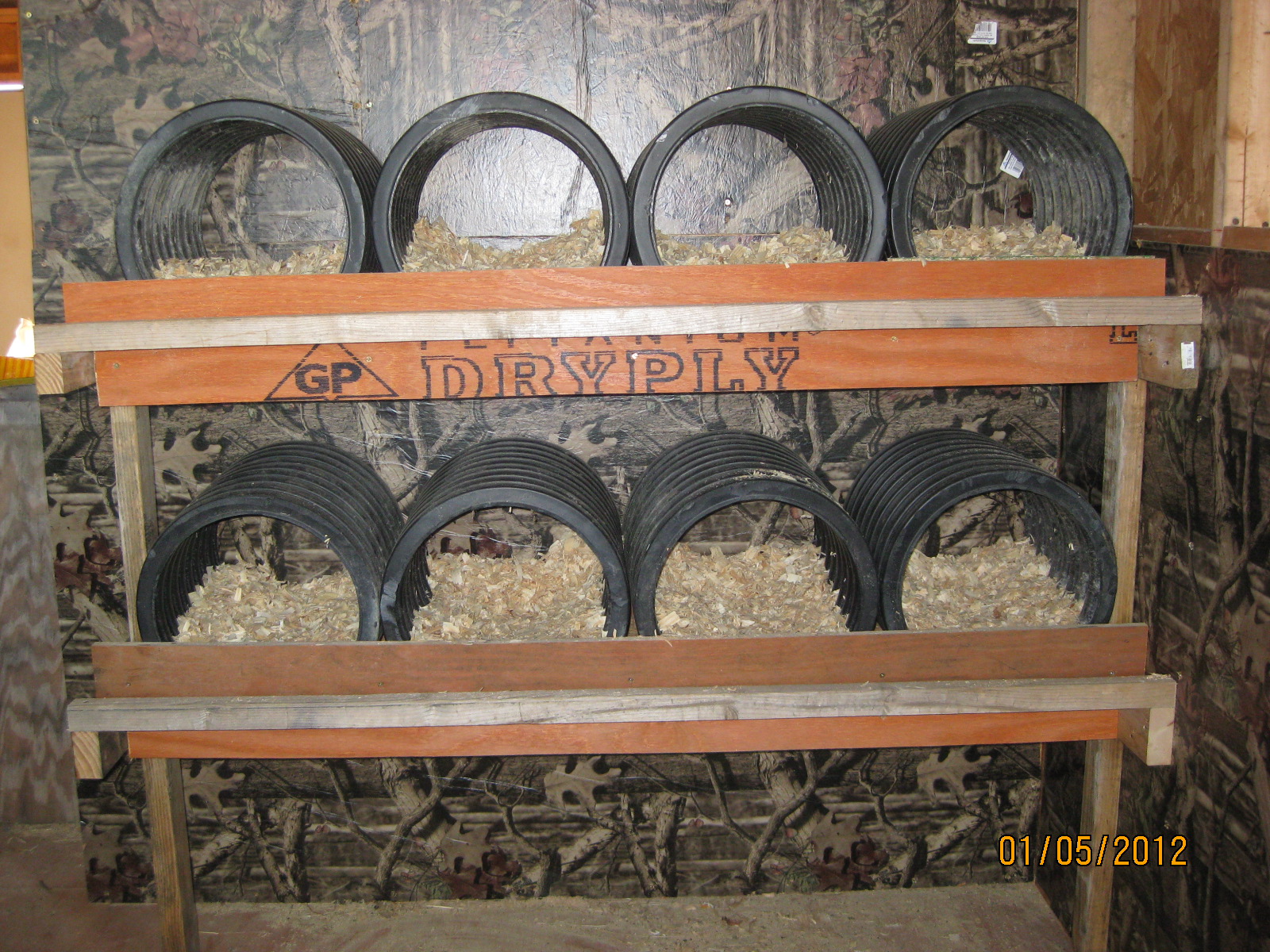 |
| These nesting boxes are made from old culvert. |
 |
| Buckets make a quick and easy nesting box. This photo shows the work in progress. |
To finish out the coop, Chris was convinced that it wouldn’t
take a lot of money. He again conceived a plan for salvaged materials,
recycling what he had, or could easily barter for, to achieve what he needed.
Form materials from pouring a bridge, a few used buckets, and some old culvert
started to take shape in his mind. Here you see examples of two different
styles that now adorn what appeared to be a boy’s bedroom just a few days
earlier.
Look closely. You’ll see the camouflage paneling, one of the
few things he bought new. Right after deer hunting season, it was the cheapest
thing at the hardware store!
 |
| OOPS! The camouflage wall is deceptive, like a hen could roost there! |
Saturday, November 26, 2011
Pullet Eggs!!! Months too soon!

Pictured is a basket of duck eggs. Beside the basket, you'll see two tiny brown eggs, gifts from a precocious Lady Sussex.
Chris opened the brooder door on her recently and she looked shocked and dismayed that he would just blatantly walk in on her while she was doing her business. There she sat feeling indignant, in a tuft of bedding she had pulled together for a nest. Chris is pretty sure she shouted, "Uh, WHAT?! SHUT THE DOOR! I'M BUSY IN HERE!" (heavy sigh)
In her disgust, she may have laid her small brown chicken egg somewhere else that day. If so, we never found it.
With winter fast approaching, this presents us with two immediate problems:
(1) The hens don't yet see the chicken condo as home, just as a place to hang out during the day. They sleep in the tiny brooder house.
(2)The chicken condo needs nest boxes that are yet to be built and some more winterization.
Soon the little hens will make the permanent migration to the chicken condo with its greener pastures. It's right next door and they're used to it. They go to it through a wire tunnel every day, range around outside for awhile, then spend the rest of the day inside. Later, toward sundown, the pullets go back through a wire tunnel to their brooder house to sleep. They've become creatures of habit. You could set a clock by them. But now, with one laying eggs already, we are so unprepared!
Another first: Roosti-Roo, our one beautiful little Sussex rooster, has learned to crow!!! He's egg-cited , I think, so he's gearing up to serve the needs of 48 hens. Poor Roosti!

Our 4 duck hens are already giving us three eggs a day, two in their nesting box and one in their pool. The ducks are also creatures of habit, we're discovering, but they provide enough eggs that I've been able to make noodles, chocolate mousse, Hollandaise sauce, have eggs for breakfast, and still share some with friends and family!
The fact that the ducks supply our egg needs brings up another problem, not so immediate, but one that needs a solution: What to do with all the chicken eggs once the hens are laying regularly? I had looked at designing a "Farm Fresh Eggs" sign for in front of the house or barn. Now I'm thinking more and more about joining the local Farmer's Market. The people who go with eggs sell out so early! But if I do, what else should I provide? I thought about making aprons but Chris says they're not a farm product. Really? So then what? I thought about little pies: Pauley's Petite Pastries. Maybe. What do you think?
Tuesday, November 8, 2011
Pauley's Pampered Poultry: Pekin Ducks
 |
| Here are the ducks in their wading pool. Once they get into the water, the ducks seem to swim in unison, clockwise, for a couple of minutes before they start splashing. |

Their favorite way to play in the water is to splash it out. Then, they waddle out of the water and drill down into the surrounding wet grass to get to the roots. Then back into the water. SPLASH! SPLASH! Eventually the water gets dirty.
Our ducks don't seem aware that they lay eggs. They just go SPLAT! and there's an egg. They give their eggs no more attention than they give their excrement and, like excrement, it can fall out anywhere--in the tall grass, by the feeder, and even in the murky water. Then,
SPLISH, SPLASH, SPLAT!
Chris tried his best to accommodate their egg-laying needs by building a nesting box for the ducks. At first, they were afraid of it. So then he put golf balls in it, but since they wouldn't come near the box and they didn't associate golf balls with eggs, that was futile. Finally, he took an egg from their murky pool and put it in the nesting box. Although their brains are small, one of them must have caught on! Now, about 1 egg in 6 can be found in the nesting box!
That's learning, one little duck waddle at a time,
maybe smaller than a baby step, but that's progress!
 | |||||
| The ducks are beginning to take notice and are getting over their fear. See the nesting box in the corner? |
Saturday, July 2, 2011
The Water Hydrant


An ancient dug well has been our water supply for the pampered poultry. After the ducks discovered their wading pools, packing water became a time-consuming chore! Now, with baby chicks in the brooder, Chris did the necessary thing. He spent a large portion of one day installing a water hydrant near the chicken condo (still in progress).
 |
| Life is good for the Pampered Poultry |
There's always something to do if you're trying to raise much of your own food. Since Chris isn't running back and forth to the well, he has more time for gardening. He'll be glad to have the hydrant for that too!
Monday, June 6, 2011
Hoop Coop
 |
| Chris completed his 10' X 20' Hoop Coop (that's what he's calling it) just in time for the ducklings' 3-week birthday. |
 |
| The ducklings wasted no time trying to learn all about their new residence. Just wait til the wading pool comes! |
 |
| Tarps and chicken wire over cattle panels should ward off predators but, just in case, the Hoop Coop is surrounded by electric fence. The potato patch is in the foreground. |
 |
| They're looking cozy! Earlier today, when Chris caught them, they must have thought they'd met their end. He picked them up just like you should, petted them and tried to calm them but they weren't happy about it. Now they have fresh air and natural ventilation, both sunshine and shade, and all the grass, bugs, feed, grit and water they could want. If it has to be a short life, at least it can be comfy! (To the ducklings: Happy 3 Week Birthday! :) Enjoy the Hoop Coop!) |
Monday, May 30, 2011
The Chicken Condo, in Progress
Measuring 18' X 36', this unit is big enough to house a small family. Instead, it will be a four-room building for housing different kinds of poultry. Little chicks that will become laying hens will be the first inhabitants. The plan includes nesting boxes, a roost, little chicken-sized doors, and a large run outside when the notion hits them. (No, the ducks won't live there. Chris is designing a kind of movable playpen for them that will include a wading pool.)
When this chicken house is finished, most of its inhabitants will be chickens we plan to raise for meat. The process is designed to give them comfortable and healthy living conditions and we plan to do this for several years.
There has been quite a bit of interest as people pass by the farm. Some stop to inquire. We're finding out several people, whether city dwellers or country dwellers, are interested in poultry. Some want a few laying hens in the new "urban farm design". Some want to duplicate what we're doing but on a smaller scale, and some want to enjoy the produce from ours. Occasionally, people take pictures of it. One new friend said he wanted to use some of the design ideas Chris has in the chicken condo for his family home but I'm not sure whether it's the piers he likes or the steel supports for the floor. Maybe it's the ample lighting, complete with skylights. See why I call it the Chicken Condo? By the way, a friend called it that, just in passing, and it stuck.
Whatever the reason, the chicken condo has attracted some attention. Some people are still wondering if it will be for rent soon. If our plan to supplement our groceries with good and good-for-you home-grown produce doesn't work out, it just might!
Wednesday, May 25, 2011
Good Day for Ducks!
The weather, being what it is, will likely do what she wants to do. Is it a good day for ducks? I asked Chris. His fact du jour was that the ducklings need to stay in their brooder and out of the rain. To allow them to swim in a pool of water could be fatal. The reason: Since Chris became their surrogate mother, they don't have the advantage of their mother's natural oil that penetrates feathers and keeps ducklings afloat on water. Besides, their brooder provides the ducklings a clean, controlled environment with steady temperatures and protection from predators.
It's working. All eleven ducks are healthy and active and, when I visit, they give me a cocked-head sideways look that only ducks can do, like they're thinking I don't know what you are or why you're even here, but I think it's time for you to leave!
Right now Chris is making a movable "schooner" so that when the ducklings can get outside, there won't be a chance for a predator to break through. He's already built a fence, electric and woven wire combined, to keep out the big critters. The ducklings will live inside this schooner that will keep out everything but sunshine, insects and small birds. Chris will move the schooner around the poultry yard from time to time to give the ducks fresh grazing. By the time they get outside, the ducklings should be ready for their wading pool.
All this for table fare? You're right, and here's why. We want to raise a portion of the meat we consume and give the animals a good life. Suppose a person eats 8 oz. of meat a day. The cost of getting started with poultry is a one-time expense, except for maintenance, and with little continued overhead. The cost of producing poultry is considerably less than beef because their weight gain is so rapid! Raising ducks requires less land than raising a steer, much less time to reach maturity, less feed per pound of weight gain, and we like the meat. So it's a good choice for us. Improved quality of life=improved meat. On top of that, the environmental footprint is greener than it would be with beef.
Is it a good day for ducks? Yes, if you're in an environment that takes care of your every need!!! That's what we're doing! And we'll keep on doing it to the end of their days!
It's all good except for one little problem: I still haven't found the white vintner grapes that I can grow in this locale that would make a really delicious and smooth wine to serve with duck.
It's working. All eleven ducks are healthy and active and, when I visit, they give me a cocked-head sideways look that only ducks can do, like they're thinking I don't know what you are or why you're even here, but I think it's time for you to leave!
Right now Chris is making a movable "schooner" so that when the ducklings can get outside, there won't be a chance for a predator to break through. He's already built a fence, electric and woven wire combined, to keep out the big critters. The ducklings will live inside this schooner that will keep out everything but sunshine, insects and small birds. Chris will move the schooner around the poultry yard from time to time to give the ducks fresh grazing. By the time they get outside, the ducklings should be ready for their wading pool.
All this for table fare? You're right, and here's why. We want to raise a portion of the meat we consume and give the animals a good life. Suppose a person eats 8 oz. of meat a day. The cost of getting started with poultry is a one-time expense, except for maintenance, and with little continued overhead. The cost of producing poultry is considerably less than beef because their weight gain is so rapid! Raising ducks requires less land than raising a steer, much less time to reach maturity, less feed per pound of weight gain, and we like the meat. So it's a good choice for us. Improved quality of life=improved meat. On top of that, the environmental footprint is greener than it would be with beef.
Is it a good day for ducks? Yes, if you're in an environment that takes care of your every need!!! That's what we're doing! And we'll keep on doing it to the end of their days!
It's all good except for one little problem: I still haven't found the white vintner grapes that I can grow in this locale that would make a really delicious and smooth wine to serve with duck.
Thursday, May 19, 2011
Lucky Duckies
The post office called at 7 a.m. to let us know our ducklings had arrived, so Chris scrambled out of the house to pick them up and get them settled into their new home. The photos are from one day later. They weren't a bit camera shy!
This particular variety of duck, the Pekin, will become white later on and are respected as table fare. I know! AWWW! But, look at it this way--we'll give them the best food and care a duckling could possibly get, providing them a very good life!
This particular variety of duck, the Pekin, will become white later on and are respected as table fare. I know! AWWW! But, look at it this way--we'll give them the best food and care a duckling could possibly get, providing them a very good life!
Tuesday, April 26, 2011
Getting Our Ducks in a Row
Chris loves a good challenge and homesteading provides several opportunities to stretch one's physical boundaries as well as knowledge base. He has been working on both a brooder and a chicken coop for our chicks, not yet arrived, and he began thinking about ducks. When Chris starts thinking about things, watch out! He'll stay up all night long reading about the topic du jour but it continues night after night until his brain is saturated with mostly valuable, sometimes useless, information that spills over. Right now he's giving me a fact a day about ducks. I'm learning a lot from him, but I have to tell you, raising ducks is something I never thought I'd be doing. So, of course, he wants to try out his new brooder with ducklings first before the chicks arrive. It makes sense, considering the weather. We've had nothing but rain and ducks love puddles!
That brings me to one of his newly discovered and amazing facts:
Did you know that, if you raise little hatchling ducks that haven't been around their mother, they don't get her natural oil and that means that, if they go into a pond without that protective oil on their feathers, they won't swim? Their feathers will instead absorb the water and the baby ducklings will sink and drown! It takes a few weeks for their own oils to coat their feathers enough to keep ducklings afloat! I don't want to test that to see for sure that it's factual so NO PONDS ALLOWED!
Today I placed our order for a few baby ducklings, Pekin ducks from Meyer Hatchery at http://www.meyerhatchery.com. These ducks will be white as adults and I'm actually getting excited.
Part of that excitement is that I enjoy an occasional meal of duck and that gets me thinking about a glass of Pinot Grigio, which reminds me--I still would like to try growing some vintner grapes! I'm looking for just a few vinifera vines that are suitable for growing in southern Ohio's clay soil and humid climate. After all, it takes planning to produce your own meal of duck with white wine but I can imagine that this venture could be fun! Anyone know of a good source for vinifera vines in Ohio? And, please, don't mention to Chris that his "foxy" lady is planning to eat his ducks. (And yes, I mean "foxy" as in "conniving"!)
As you can see, whether ours is a marriage made in Heaven or not, Chris and I were meant for each other. We bought ourselves a beautiful and cherished calligraphy painting for our first anniversary almost 28 years ago that says it all: I was meant for someone who welcomes a challenge!
That brings me to one of his newly discovered and amazing facts:
Did you know that, if you raise little hatchling ducks that haven't been around their mother, they don't get her natural oil and that means that, if they go into a pond without that protective oil on their feathers, they won't swim? Their feathers will instead absorb the water and the baby ducklings will sink and drown! It takes a few weeks for their own oils to coat their feathers enough to keep ducklings afloat! I don't want to test that to see for sure that it's factual so NO PONDS ALLOWED!
Today I placed our order for a few baby ducklings, Pekin ducks from Meyer Hatchery at http://www.meyerhatchery.com. These ducks will be white as adults and I'm actually getting excited.
Part of that excitement is that I enjoy an occasional meal of duck and that gets me thinking about a glass of Pinot Grigio, which reminds me--I still would like to try growing some vintner grapes! I'm looking for just a few vinifera vines that are suitable for growing in southern Ohio's clay soil and humid climate. After all, it takes planning to produce your own meal of duck with white wine but I can imagine that this venture could be fun! Anyone know of a good source for vinifera vines in Ohio? And, please, don't mention to Chris that his "foxy" lady is planning to eat his ducks. (And yes, I mean "foxy" as in "conniving"!)
As you can see, whether ours is a marriage made in Heaven or not, Chris and I were meant for each other. We bought ourselves a beautiful and cherished calligraphy painting for our first anniversary almost 28 years ago that says it all: I was meant for someone who welcomes a challenge!
Subscribe to:
Posts (Atom)