Welcome to The Pauley Principle!

The Pauli Principle, named for Wolfgang Pauli, deals with atoms and electron-sharing that results in new, stronger bonds. Think 2 parts hydrogen and 1 part oxygen, a shared delectable (!) electron and VOILA! Water!

Similarly, when you prepare whole food to share with family and friends, especially foods you've grown, something amazing happens. Meals become tastier and healthier. Your soul, not just your stomach, becomes fulfilled. You live life more abundantly as a result. During a shared meal, the bonds that people create grow stronger and become something new: GREATER than the sum of the parts! I give you The Pauley Principle.
Showing posts with label cooking. Show all posts

Tuesday, February 14, 2012

A Photo Essay

There is something visceral, very REAL, about our connection with the land when we grow, harvest and preserve great food and drink for the table. Sharing the food  and experiences with others becomes incredibly fulfilling. Chris and I have discovered that magic. 


In this blog, I share our experiences, successes and frustrations with our particular brand of homesteading that includes chickens, gardening, cooking, food preserving, and building projects. You will find an occasional recipe, some research or an idea that makes life easier. And if I occasionally make you laugh or help lighten your load, that makes me happy. 


When you prepare food to share with family and friends using whole food products, especially what you've grown, you'll serve up meals that are tastier, healthier, and your soul will overflow with fulfillment. You will be living abundantly. Work with your right hand and share with your left. In all you do, act of out love. Your life will become more than the sum of your parts. This is The Pauley Principle.

Thursday, December 29, 2011

Solutions for Left-over Ham! Two REALLY Easy, REALLY Delicious Recipes!

One more meal of sliced ham but then what?

Here are three things to help you stretch the ham dollar and give you more tasty meals:
1. First, freeze the large slices in usable portion size. 
2. Chunk up the rest for yummy ham salad. (Recipe follows.) Leave some meat on the bone.
3. Make a delicious and nutritious bean soup with the ham bone and those luscious pieces of ham that cling to it. (Recipe follows.)

These recipes are incredibly easy and delicious!


HAM SALAD

Start with a ham that is tasty and not dried out. A little ham fat adds flavor, but be skimpy with it. Trim carefully so as not to get gristle or chunks of fat.
I prefer to use an inexpensive grinder but I've had ham salad that is minced or chopped and it's just fine. A food processor would also give a great result. The important thing is that you use real ham, real eggs, a good quality of mayonnaise, and some pickle relish. That's it! This is SO EASY!!!

1 1/2 to 2 cups of ham, chopped fine or ground
3 to 4 eggs, boiled, shelled, chopped fine or ground
2 heaping tablespoons of mayonnaise (Hellman's is so good for this!)
1 heaping tablespoon of sweet pickle relish


Really, that's it! Just process the meat and eggs to the consistency you like. Add the mayonnaise and the sweet pickle relish. Stir it up, adding more mayonnaise or pickle relish to taste,  incorporating the flavors throughout and WOW!!! 100% Pure YUM and I guarantee you can't buy a ham salad that tastes that good and fresh! Makes a great sandwich with potato soup. Oh, yeah! Or serve with crackers.
Feel free to add onions, but your ham salad won't stay fresh-tasting as long.


BEAN SOUP

1 ham bone
1 pound of navy beans
2 sticks of celery, chopped
1/2 onion, diced
sweet pepper or hot pepper, diced, to taste
2 teaspoons salt
generous pinch of freshly ground pepper
2 quarts of water to start, or enough to cover the ham bone

You can parboil the beans ahead of time, if you like. I always rinse the beans and check for little rocks but it's really pretty rare to find one! Just an old-timey habit!

Simply place all ingredients into a stock pot. Place on high heat to bring to boil. Turn down the heat to simmer, cover, and simmer for 1 1/2 to 2 hours. Add water as needed. Check seasonings and adjust. 
Serve with cornbread. What a treat!!!

Question: What are some of your favorite ways to use your left-over ham or ham bone?


Chopping, Chopping Broccoli!

Remember Dana Carvey's Saturday Night Live Skit? I can't get it out of my head!

While Chris is out chopping firewood, I find myself chopping veggies and thinking about how he always says I'm using the wrong tool when I chop vegetables. (I tend to reach for the carving knife.) When I watch cooking shows on TV, he points out the knives the cooks are using. He should know. He's all about his tools. That's why he made the nutcracker for me!

A few years ago, Chris bought himself a Wusthof knife for hunting. He made the mistake of bringing it into the kitchen and I just love it, so when I saw this special Wusthof knife that Chef's Catalog is offering, I knew I had to tell you about it. This offer is a real deal at 64% off for a Wusthof Silverpoint II Nakiri 7-inch knife. Check out its design. The special price is just until January 3, so hop on it if you need one! Chris says, "Always use the right tool for the job." I say, "Buy once, but buy a good one!"

<a href="http://gan.doubleclick.net/gan_click?lid=41000613802179547&pubid=21000000000514512">Wusthof Silverpoint II Nakiri, 7-inch</a>
"http://gan.doubleclick.net/gan_click?lid=41000613802179547&pubid=21000000000514512"

I hope this link works for you but if this doesn't show the photo, try the link on the sidebar. I'm hoping you'll try it. If you do, Chef's Catalog will thank me, and I'll thank you! Remember, time is running out!

Saturday, December 3, 2011

Making Venison Jerky


A friend of ours, Shaun, sent some beautiful venison steaks to me with the message:
Do something with it! 

I guess he didn't have time. For us, it was too much for one meal and late at night. The beautiful pieces of meat, about 1/4" thick, had been frozen but were thawed when he sent it. I decided to turn it into jerky. First I needed to gather supplies. Then I needed a seasoning blend.

Supplies: a baking pan, a cookie rack or some other suitable drying rack, a meat tenderizer, a wooden board. Now, when I say meat tenderizer, I mean a tool that looks like a hammer that has a rough face, not a blend of chemicals.

Seasonings that I've made in the past were teriyaki, garlic, and hot and spicy. I make my own blend with a Krups spice grinder, but there are perfectly good blends on the market. For this jerky, I made it mildly spicy, although just being near the blend while I was grinding it could take your breath away. I started coughing! The seasonings I chose were: red pepper flakes, paprika (for another layer of depth and smokiness), salt, and black pepper. Experiment with amounts to suit your taste. Very simple.  (None of those other terms you'll see on Uncle Buck's such as hydrolized soy protein, dextrose, caramel color, potassium sorbate, sodium erthorbate, or sodium nitrate.) I want a product that's good for you, not one that will last my lifetime!
This tenderizer makes seasoning and pounding easy.

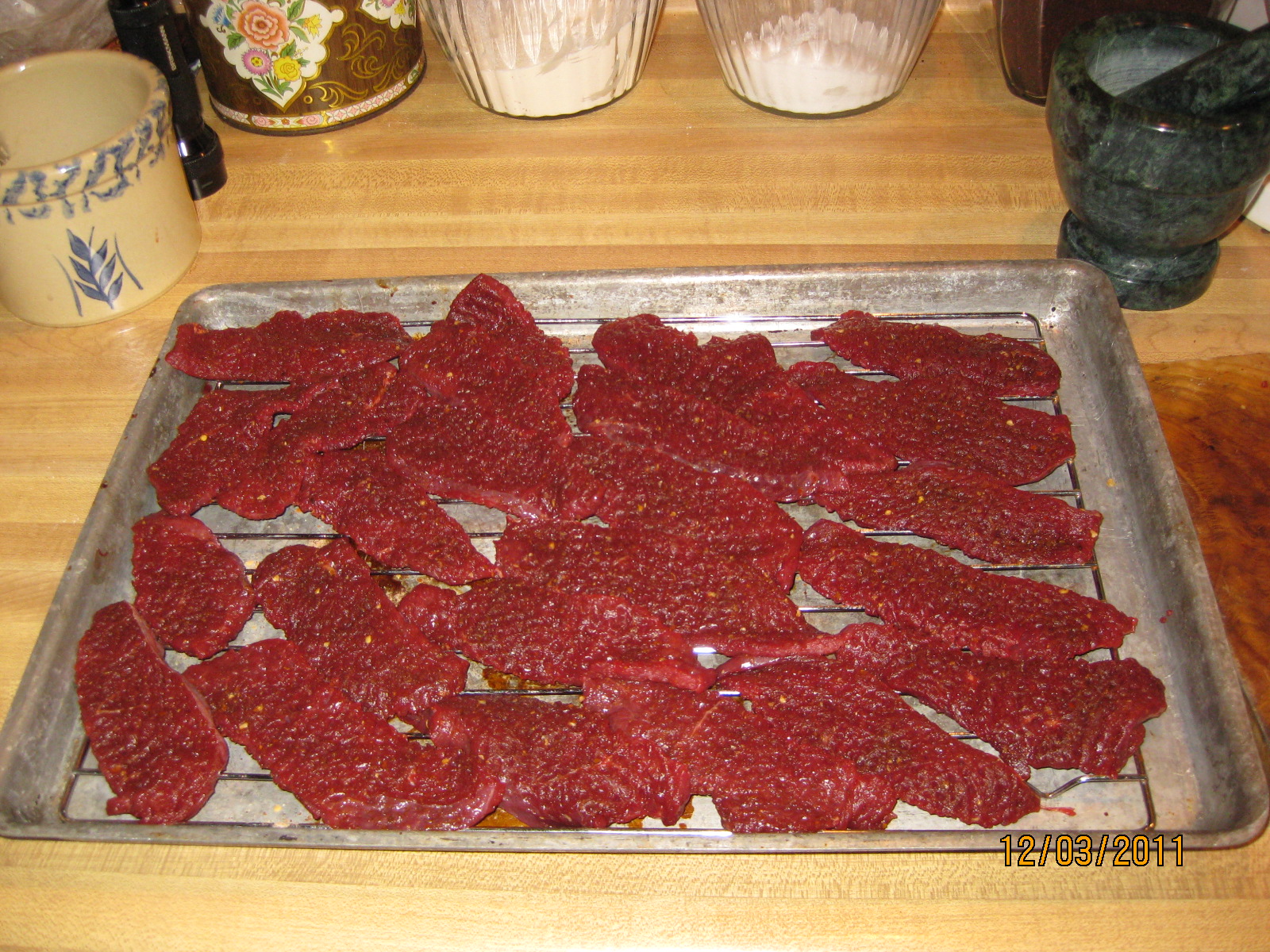
Lay the seasoned, pounded pieces on the rack.


Begin by laying out your meat on the cutting board and sprinkling each piece liberally with your seasoning blend. Use the tenderizer to pound the pieces to almost half the thickness. Turn the pieces over, sprinkle with seasoning, and pound. When you're finished, your pieces should be about 1/8" thick or so.

Place on an oven-proof rack on a baking sheet. Put into a 170 to 200 degree F oven for about 4 hours. Turn. Watch them in about an hour and check for dryness. The pieces, still warm, should have a little flex to them. They don't need to be perfectly brittle. As they cool, they'll lose more moisture. Cool completely before wrapping for storage.

The rack allows plenty of air movement so that the jerky won't stew in its broth.
Shelf life depends on the amount of salt you use. Jerky doesn't last long at our house. I put some on the table and then, WHOOSH! It's gone! There are other modern ways to make jerky: You can soak the pieces in a brine. You can use a food dehydrator. I've done those and those methods work fine. The method I've described is easy to do and the result is just as delicious!


Thursday, November 10, 2011

How to Make Pumpkin Puree


The best things in life are messy. Making your own pumpkin puree is no exception. What makes it so worth it is the fresh full flavor you'll get when you bake with it!


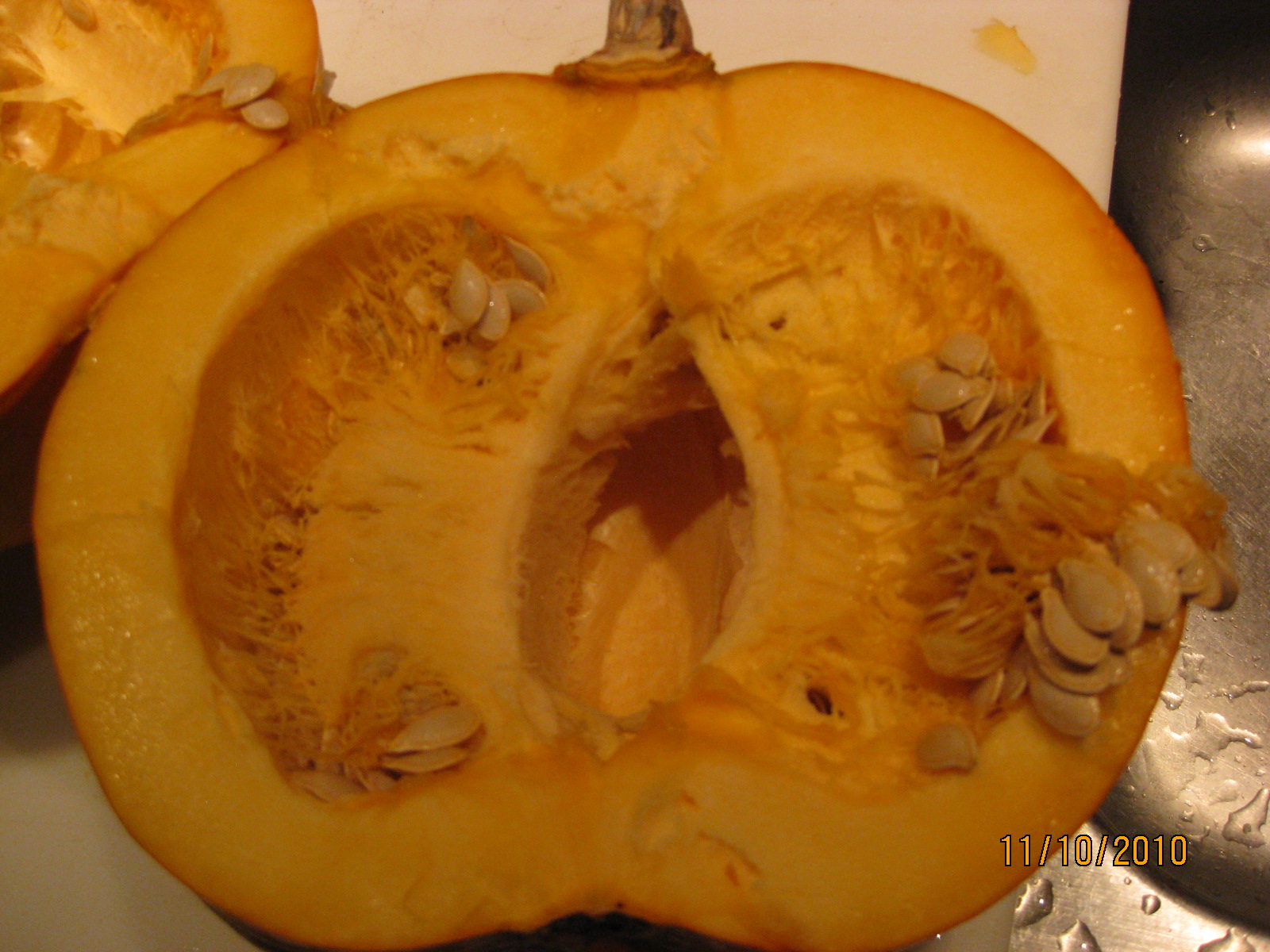
Start with a perfectly good pumpkin. It doesn't have to be large. Even this small one to the right had 2 cups of pulp. Cut your pumpkin in half. Get ready to get messy if you do this or just use a large spoon. Either way, remove the seeds. Then, place your pumpkin cut-side-down in a large pan. Fill halfway up the pumpkin with water and bake at 400 degrees F for about 45 minutes. Allow to cool before scooping the pulp into a blender. Simply puree the pulp until smooth. Then you're ready to use the puree in your favorite pumpkin recipes!