Welcome to The Pauley Principle!

The Pauli Principle, named for Wolfgang Pauli, deals with atoms and electron-sharing that results in new, stronger bonds. Think 2 parts hydrogen and 1 part oxygen, a shared delectable (!) electron and VOILA! Water!

Similarly, when you prepare whole food to share with family and friends, especially foods you've grown, something amazing happens. Meals become tastier and healthier. Your soul, not just your stomach, becomes fulfilled. You live life more abundantly as a result. During a shared meal, the bonds that people create grow stronger and become something new: GREATER than the sum of the parts! I give you The Pauley Principle.

Thursday, June 30, 2011

52 Hot Chicks on the Run! The Speckled Sussex babies have arrived.

The USPS does a great job of transporting chicks. An early morning phone call lets you know the chicks are at the Post Office and we can either pick them up or they'll deliver by truck. In no time at all, Chris was on the road to pick up his chicks. These hot chicks were shipped out the day they hatched. That's quick. 


Since the little chicks are naturally warm and have to stay that way, their brooder has to be kept in the 90's during the early days of their lives. The brooder stood waiting and ready.

The first thing Chris noted when he took the 52 little Speckled Sussex chicks out of their mailing box is that they could RUN! They seem to actually prefer running. Whether they're on their way to food, water, or to chase a fly, they run.

What makes it even more fun is that the chicks will also run to us! They actually seem friendly! 
And Chris is determined to keep them friendly.

The chicks are in a climate controlled brooder. After the brooder, they might get to live in the hoop coop since the weather will be suitably warm. Then it will still be several months before these chicks will produce eggs. After a few weeks in the hoop coop, as fall nears, they'll move into the chicken condo where they will still have the opportunity to get out in the yard for some real foraging. This is going to be FUN! What's fun that isn't also a little work? And we're hoping to enjoy having them  for many years Besides, what other pet do you know that can lay an egg?

Wednesday, June 15, 2011

The Haystack

Chris is tossing the hay up into the haymow.

He has some great ideas for using the hay!

Whatever he's thinking, at least he's motivated to get this job done in a hurry!

This was just the first of three trailer loads! He says it will fit and he should know. He built this barn!
Making hay the old-fashioned way! When you've just got a small field and a little time to spare, it could be the green thing to do! Note, however, the absence of horses and a hay wagon. Admittedly, it's not the perfect shade of green but definitely gave a great workout for all involved!

Monday, June 6, 2011

Hoop Coop

Chris completed his 10' X 20' Hoop Coop (that's what he's calling it) just in time for the ducklings' 3-week birthday.

The ducklings wasted no time trying to learn all about their new residence. Just wait til the wading pool comes!

Tarps and chicken wire over cattle panels should ward off predators but, just in case, the Hoop Coop is surrounded by electric fence. The potato patch is in the foreground.

They're looking cozy! Earlier today, when Chris caught them, they must have thought they'd met their end. He picked them up just like you should, petted them and tried to calm them but they weren't happy about it. Now they have fresh air and natural ventilation, both sunshine and shade, and all the grass, bugs, feed, grit and water they could want.
If it has to be a short life, at least it can be comfy!
(To the ducklings: Happy 3 Week Birthday!  :)  Enjoy the Hoop Coop!)


Sunday, June 5, 2011

Making the Salsa Bed

Chris hated breaking his last night's promise to plow the backyard garden today. He was planning to use his Gravely. It's an antique, I think, but this would be our first experience with it for the garden so we were both excited to see how it did. Last night's 9/10" rained spoiled our plans and Chris was back on the farm instead with the Gravely doing some sickle bar mowing around the pine trees instead.

So, without any kids, without any visitors, and without the Gravely, that left me to try to find a way to get my vegetable seedlings into the ground--finally! I'd already wasted my first batch of tomato sprouts since I started them in February, afraid I'd run out of salsa before I had more tomatoes! Pretty foolish, I know! But now I had seedlings that weren't growing well because they needed outside in rich garden soil, rain and real sunshine. The first thing I did was to take inventory of the cold frame where my mix of lettuces and kale had been. There were a few stragglers, so I pulled them out, washed them up in the kitchen and allowed them to drain while I yanked out the weeds that had overtaken their space. 
All afternoon I worked, yanking weeds and preparing the soil for the new arrivals. I planted in the rain so no need to water further, I figured. I was a happy gardener, not really knowing how to go about crowding my veggies. I decided to do it a little like raised bed gardening since the veggies would have to be in there tight. The first thing that went in were the sweet potatoes. I had to have a place for them since the voles at the potato patch were horrible little monsters! They would eat them up underground and we wouldn't have a clue until harvest time. (But aha! We have now erected a raptor perch, hoping to attract hawks to find the voles since voles also eat pine roots, but I digress. The pines are a totally different topic.) Back to my gardening:

 In the very back I have yams and sweet potatoes. This frame has eight inches of topsoil and sand above the ground, so I suppose the potatoes will have room to burrow. In front of that are six yellow tomato plants. In the very front I have planted my ten little mixed pepper plants. I will dub this bed my "salsa bed".


One surprise: In with my pepper seedlings was one lonely unidentified tomato that I mistakenly labeled and treated like a pepper. So I potted it and it will become someone's mystery tomato patio plant.

Saturday, June 4, 2011

Raspberry Jelly!

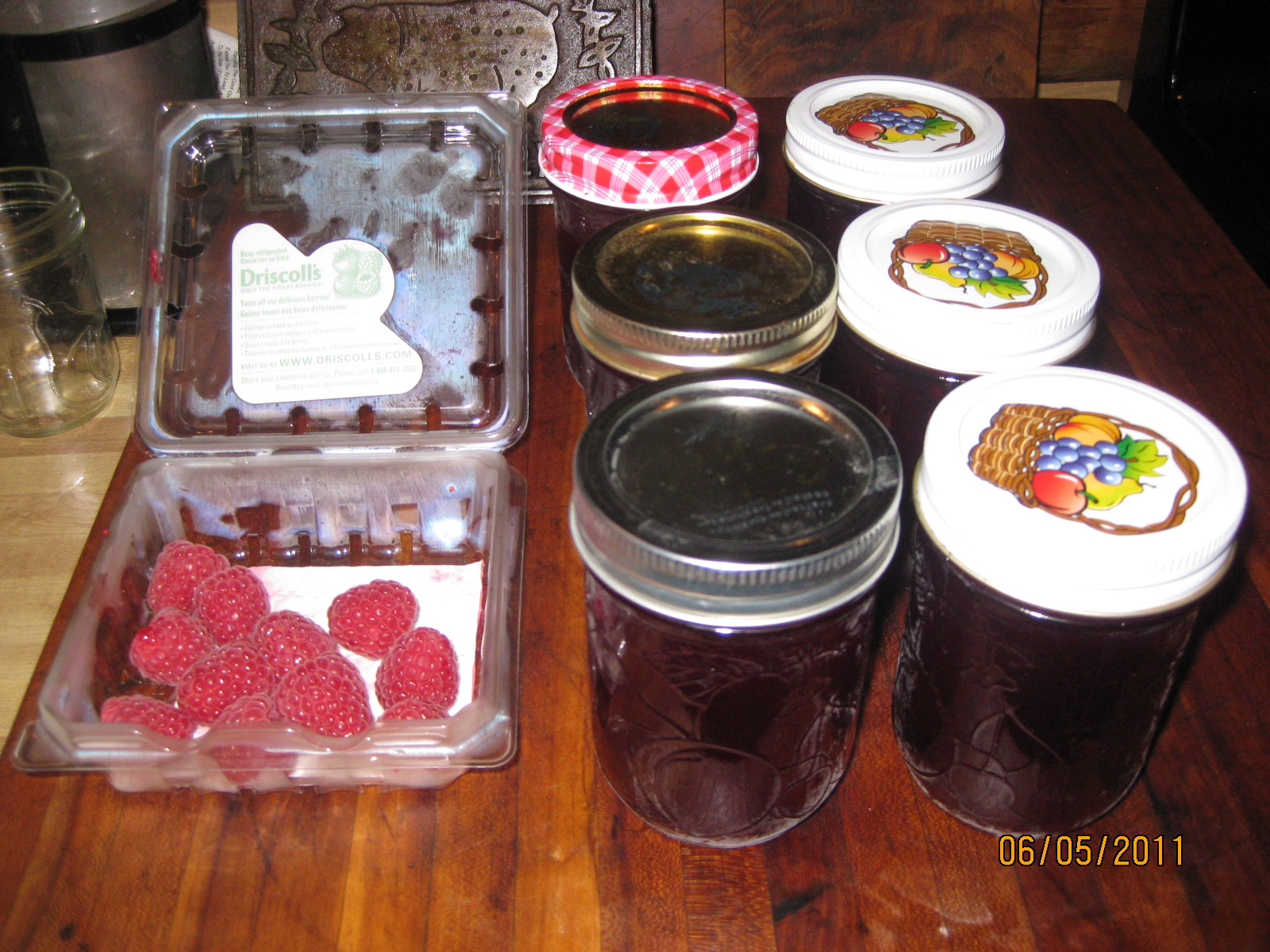
I have three young red raspberry vines in the berry patch. No way could they produce the two quarts needed for one small batch of jelly, so when I saw fresh California raspberries at a great price, I gritted my teeth  and latched onto enough to do it! It didn't matter that I had enough chores lined up that I couldn't see an end in sight.  I would find the time to make red raspberry jelly!

One tip, fresh from the pectin package directions: Hold back a few berries if you want a thicker jelly. I was going to anyway just because, well, they're fresh berries!  :)  I'll still watch the farmers' markets for the local berries unless my little berry patch produces a humongous amount of berries this year!

Making jelly takes a little longer than making jam but the result is a smooth spread with no annoying seeds to get stuck in your teeth. On the other hand, jams and preserves give you the pulpy sensation of fresh berries. I like them all but if you want a smooth spread, you may want to plan for the additional items needed and the time involved. The result is worth it. 
So I gathered all my tools together before I started cleaning the berries. This time I decided to use my trusty tomato presser from last year's tomato processing. This little handcrank machine (top pic on the left) would remove seeds of the raspberries instead of my mashing them by hand as the directions said or using a food mill. Using this presser is a workout and it's a little awkward to put together, but it's effective. This step cuts down the time needed to strain the clear, fragrant juice that will turn into jelly. Then, once you start cooking, it goes so fast! Have the jars ready!  Two quarts of red raspberries should produce six cups of jelly.

Wednesday, June 1, 2011

LIFE IS DUCKY!!!

Just for fun, I gave them a little waterer inside a feedpan! They splashed the water out and for a few minutes there was a pool party! Just wait til they get their wading pool!

Water cooler gossip! You can tell something's on their minds. Look at the way they're avoiding my eyes. 

Hard to imagine these lanky birds are just fourteen days old. They're starting to grow tail feathers.

The Potato Patch

The leaves of these potatoes are looking really healthy, no bugs in sight!

Growing Potatoes

Over the past three years we have tried our best to be green with growing potatoes, attacking the dreaded potato beetle with our bare hands. Chris would get out and hand pick the bugs from the potatoes, not wanting to kill the praying mantis babies that we hoped would get the job done. Sometimes he would pick potato beetles for an hour, counting and one day catching more than 600 bugs over several hours, only to see more coming onto the plants later that evening. A single bug can easily destroy a plant in a day, so imagine what just a hundred could do!

One of the problems with potato beetles is that the larva is underground where you may not notice them until they emerge from the ground as fully developed bugs with voracious appetites. Our solution? Imidocloprid, sold as Nuprid. Treating the soil seems to be effective, halting the development of the larva in the early spring, prior to planting potatoes. The potato crop is coming along really well without the lacy leaves associated with bug damage.

We'd rather be green about our veggies, so if anyone has a practical solution for potato beetles, please pass it on! I hear ducks eat them and we have some ducks that go into a feeding frenzy when they see a cricket so what would they do in an infested potato patch? I have to wonder!

Monday, May 30, 2011

The Chicken Condo, in Progress

Measuring 18' X 36', this unit is big enough to house a small family. Instead, it will be a four-room building for housing different kinds of poultry. Little chicks that will become laying hens will be the first inhabitants. The plan includes nesting boxes, a roost, little chicken-sized doors, and a large run outside when the notion hits them. (No, the ducks won't live there. Chris is designing a kind of movable playpen for them that will include a wading pool.)

When this chicken house is finished, most of its inhabitants will be chickens we plan to raise for meat. The process is designed to give them comfortable and healthy living conditions and we plan to do this for several years.

There has been quite a bit of interest as people pass by the farm. Some stop to inquire. We're finding out several people, whether city dwellers or country dwellers, are interested in poultry. Some want a few laying hens in the new "urban farm design". Some want to duplicate what we're doing but on a smaller scale, and some want to enjoy the produce from ours. Occasionally, people take pictures of it. One new friend said he wanted to use some of the design ideas Chris has in the chicken condo for his family home but I'm not sure whether it's the piers he likes or the steel supports for the floor. Maybe it's the ample lighting, complete with skylights. See why I call it the Chicken Condo? By the way, a friend called it that, just in passing, and it stuck.

Whatever the reason, the chicken condo has attracted some attention. Some people are still wondering if it will be for rent soon. If our plan to supplement our groceries with good and good-for-you home-grown produce doesn't work out, it just might!

Wednesday, May 25, 2011

Good Day for Ducks!

The weather, being what it is, will likely do what she wants to do. Is it a good day for ducks? I asked Chris. His fact du jour was that the ducklings need to stay in their brooder and out of the rain. To allow them to swim in a pool of water could be fatal. The reason: Since Chris became their surrogate mother, they don't have the advantage of their mother's natural oil that penetrates feathers and keeps ducklings afloat on water. Besides, their brooder provides the ducklings a clean, controlled environment with steady temperatures and protection from predators.

It's working. All eleven ducks are healthy and active and, when I visit, they give me a cocked-head sideways look that only ducks can do, like they're thinking I don't know what you are or why you're even here, but I think it's time for you to leave!

Right now Chris is making a movable "schooner" so that when the ducklings can get outside, there won't be a chance for a predator to break through. He's already built a fence, electric and woven wire combined, to keep out the big critters. The ducklings will live inside this schooner that will keep out everything but sunshine, insects and small birds. Chris will move the schooner around the poultry yard from time to time to give the ducks fresh grazing. By the time they get outside, the ducklings should be ready for their wading pool.

All this for table fare? You're right, and here's why. We want to raise a portion of the meat we consume and give the animals a good life. Suppose a person eats 8 oz. of meat a day. The cost of getting started with poultry is a one-time expense, except for maintenance, and with little continued overhead. The cost of producing poultry is considerably less than beef because their weight gain is so rapid!  Raising ducks requires less land than raising a steer, much less time to reach maturity, less feed per pound of weight gain, and we like the meat. So it's a good choice for us. Improved quality of life=improved meat. On top of that, the environmental footprint is greener than it would be with beef.

Is it a good day for ducks? Yes, if you're in an environment that takes care of your every need!!! That's what we're doing! And we'll keep on doing it to the end of their days!

It's all good except for one little problem: I still haven't found the white vintner grapes that I can grow in this locale that would make a really delicious and smooth wine to serve with duck.

Thursday, May 19, 2011

Lucky Duckies

The post office called at 7 a.m. to let us know our ducklings had arrived, so Chris scrambled out of the house to  pick them up and get them settled into their new home. The photos are from one day later. They weren't a bit camera shy!

This particular variety of duck, the Pekin, will become white later on and are respected as table fare. I know! AWWW! But, look at it this way--we'll give them the best food and care a duckling could possibly get, providing them a very good life!

Wednesday, May 4, 2011

The Three Sisters and Friends

People ask me what they should try to grow if they have a small garden. My first thought: tomatoes! They're so adaptable to meal plans. My second thought: potatoes! No longer relegated to the garden, they are emerging as horticultural plantings for landscapes, make a very pretty ground cover and provide delicious spuds that can be prepared for the table in a multitude of ways. My third thought: "The Three Sisters", quite possibly responsible for the success of both the early native Americans and the immigrants who came later to live and thrive here in America.

In early times, before recorded history in America, the people who inhabited the land would plant beans, corn and squash together. The three vegetables came to be called "The Three Sisters" and became standard. This planting combination had been a brilliant agricultural plan, ingenious in the way the plants complemented each other. The way it worked, stalks of corn provided a structure for climbing beans. In turn, beans brought nitrogen from the air down into their roots and into the soil where the corn, which has to have nitrogen, could use it. Beans and corn together would provide a great protein source, especially important when meat could not be found. Squash provided the perfect vining ground cover to fight weeds and hold in moisture, proving to be even better because it was edible. Our early Americans valued both its flowers and its fruit.

If you have the room, I would suggest all these vegetables but, especially, garden with the three sisters. They worked in olden days in the garden and will continue working today!

Tuesday, May 3, 2011

The Ark of the Chicken Condo

Ohio's rainiest April in recorded history has slowed down progress on the chicken condo only a little. With intense fervor, Chris still gets out there everyday and makes some progress but I am beginning to question what he is building. First, he loves animals and wants some to care for. Second, the rains just keep coming. Third, he's already expanded from chickens into ducks and, fourth, the project keeps growing. I'm convinced that he's building, not a tiny little chicken coop. I think he's building an ARK!

Chickens? I wonder. Chris and I were both involved in and traumatized by the primitive methods of preparing a chicken for the table when we were kids. If more people participated in that process or any other meat preparation, they might develop a greater appreciation and reverence for the animal that gives its life for our sustenance and, as a result, our nation of meat-eaters might consume less meat. Getting back to an intimacy with our food couldn't help but make us healthier as a nation. Children now are so far removed from the source of their meat that the habits of disregarding the life of the animal are well-ingrained and chicken in our country is consumed at an enormous rate! That has led to production practices that often appear to be inhumane.

I'm not the only one who feels this way. The author of The Color Purple, Alice Walker, has chickens in her backyard. I heard her interview on the Diane Reames Show on NPR. Her current experiences with chickens has caused a backlash of childhood memories of chicken day and a renewed reverence for animals. The childhood "trauma" she experienced caused her to try a vegan diet for awhile but she is back now to eating some meat, including chicken occasionally. She has written a memoir of her thoughts, her travel adventures and letters to her chickens. No kidding.

And that brings me back to this project Chris is preparing. Whether it's an ark or a chicken coop, I'm convinced that whatever lives in or around it will be treated with the utmost care and respect with windows and a movable yard where they can "graze" and find insects because chickens like to do that. Will the rains subside? Will we soon learn his true intention? I can only hope. The ducks arrive soon, followed by chicks, and then who knows? If they arrive 2 X 2, from where you sit now, you'll be able to hear me!

Tuesday, April 26, 2011

Getting Our Ducks in a Row

Chris loves a good challenge and homesteading provides several opportunities to stretch one's physical boundaries as well as knowledge base. He has been working on both a brooder and a chicken coop for our chicks, not yet arrived, and he began thinking about ducks. When Chris starts thinking about things, watch out! He'll stay up all night long reading about the topic du jour but it continues night after night until his brain is saturated with mostly valuable, sometimes useless, information that spills over. Right now he's giving me a fact a day about ducks. I'm learning a lot from him, but I have to tell you, raising ducks is something I never thought I'd be doing. So, of course, he wants to try out his new brooder with ducklings first before the chicks arrive. It makes sense, considering the weather. We've had nothing but rain and ducks love puddles!

That brings me to one of his newly discovered and amazing facts:
Did you know that, if you raise little hatchling ducks that haven't been around their mother, they don't get her natural oil and that means that, if they go into a pond without that protective oil on their feathers, they won't swim? Their feathers will instead absorb the water and the baby ducklings will sink and drown! It takes a few weeks for their own oils to coat their feathers enough to keep ducklings afloat! I don't want to test that to see for sure that it's factual so NO PONDS ALLOWED!

Today I placed our order for a few baby ducklings, Pekin ducks from Meyer Hatchery at http://www.meyerhatchery.com. These ducks will be white as adults and I'm actually getting excited.

Part of that excitement is that I enjoy an occasional meal of duck and that gets me thinking about a glass of Pinot Grigio, which reminds me--I still would like to try growing some vintner grapes! I'm looking for just a few vinifera vines that are suitable for growing in southern Ohio's clay soil and humid climate. After all, it takes planning to produce your own meal of duck with white wine but I can imagine that this venture could be fun! Anyone know of a good source for vinifera vines in Ohio? And, please, don't mention to Chris that his "foxy" lady is planning to eat his ducks. (And yes, I mean "foxy" as in "conniving"!)

As you can see, whether ours is a marriage made in Heaven or not, Chris and I were meant for each other. We bought ourselves a beautiful and cherished calligraphy painting for our first anniversary almost 28 years ago that says it all:   I was meant for someone who welcomes a challenge!

Thursday, April 21, 2011

Venison Stew, also works for beef and pork, for the crock pot

Step One:  Heat the butter and oil in a frying pan. Add seasonings to flour or cornmeal. Dredge the meat and then brown in the oil.
1 pound of meat, cut into 1" cubes
2 T. butter (or 1 if using beef or pork)
2 T. olive oil (or 1 if using beef or pork)
1/2 tsp. salt
pinch of pepper
dried thyme
flour or cornstarch for dredging

Step 2:  Place meat in the bottom of a crock pot. Add the following and turn hear to high. When hot, turn the heat to low and allow to simmer for 6 to 8 hours.
2 stalks of celery, cut into 3/4 " chunks
3 potatoes, cut into 1" cubes
3 carrots, cut into 3/4 " chunks
1/2 tsp. salt
pepper
3 cups water
You can also add chopped or pearl onions (they look so cute!) or minced garlic. Suit your tastebuds. I do it different ways depending on the people around the table.

Step 3: After all that simmering, add the following. Stir and heat through.
1 cup peas
1/2 cup chopped mushrooms
1 tsp. savory
1/2 tsp. ground thyme
1/2 tsp. of tarragon
additional salt and pepper to taste

Step 4: Add a thickening agent.
EITHER
Use 1 T. butter in a saute pan and lightly brown 1 T of flour in it, then add 1/2 cup of water and stir until smooth before stirring into the crock pot
OR
Dissolve 1 tsp. cornstarch into 1/2 cup water and stir into the crock pot.

Turn heat back on high for 10 minutes before serving.
Serving suggestion:  Fresh homebaked bread, fried mushrooms, a glass of cranberry juice. Earthy, full of flavor, and comfy!

Wednesday, April 20, 2011

Mini and Me in the Mushroom Forest

For the second day in a row, I found myself living off the grid. Actually, not so much off the grid as that the grid was off. Two days of wind, rain, and then last night's hail and I could see clearly that Nature was making a game of the grid. Forget firing up the fossil fuel generator. This was a gift! Forget chores. It meant mushroom hunting time had come and I had the additional gift of a few hours before I had to get to work!

I gathered up Mini, my calico mushroom cat, and we went to my favorite mushroom-finding place. It's not so much that she finds mushrooms as that she just loves being out stalking with me. Today, I could actually smell the mushrooms. Maybe Mini can too. I haven't asked.

After a few minutes I was dismayed that my early training in tree identification was failing me. I would head out to a tall elm tree only to find a profusion of robbed acorn shells and a scattering of oak leaves. That would be heartbreaking to my dad who was a timber buyer, purveyor of the finest in veneers. The only thing that consoled me was remembering the names of the many wildflowers I found, the wild phlox, spring beauties, yellow violets, may apples and many more. The vegetation looked like mushroom country.

Sure enough, Mini and I found some mushrooms, just nineteen, but each one excited me every bit as much as the first one. I cut the morels neatly at the ground's edge, dropped them carefully into a bread bag and felt thankful for each gift.

Throughout this hunt, my hoodie had protected me from the fine mist in the air as I kept my eyes on the ground. Mini didn't seem to mind the cool mist but, before long, she meowed loudly, that urgent sound cats make and you know that, to them at least, it's important. Not wanting the claws to come out, I pulled myself up out of my mushroom stupor, pulled my eyes up off the ground, and saw the  tree tops being whipped all around by the wind. I thanked Mini and we headed back to the house, mushrooms in tow, and our time together well spent.

Saturday, April 16, 2011

There's a Fungus Among Us!

April and May mean mushroom hunting season to many Ohioans! If all you've ever had are the button mushrooms or crimini, then you may not understand the crazed hobby of going out to find morels. The thrill of the hunt is so fun and then, wow! Eating the morel is a uniquely delectable experience that is as nutritious as it is delicious!

First of all, morels have it all over the button, portabella and crimini mushrooms for nutritional value. According to Dr. Weil on his website, these other mushrooms contain natural carcinogens. If you must eat store-bought mushrooms, he suggests you go for the shitake and enoki, both cancer fighting. Additionally, the shitake encourages the body to absorb cholesterol and sweeps it, to some extent, out of the bloodstream. But it is the morel that is the big winner for mushroom nutrition.  The morel can actually improve heart conditions due to its high levels of copper, vitamin E and potassium, according to the University of Illinois at Urbana-Champaign where they've performed a mushroom study and posted their findings in the Journal of Agricultural and Food Chemistry.

Stalking the morel mushroom for the avid hunter is every bit as exciting as finding Easter eggs for a young child but eating the morel is also a huge treat, a bit more exciting than cracking open a boiled egg.

You can prepare mushrooms and serve them in any number of great presentations but my favorite mushroom meal is a simple garden salad, freshly-caught and fried bluegills or bass, mushrooms fried with an egg-cornmeal batter, and a slice of home-baked bread with real butter. In order to do that, you have to over-indulge your senses by actually going fishing, mushroom hunting and then eating one of the best meals imaginable! If you're able to do that within a 2-day span, perhaps you've just died and gone to Heaven but I've lived to experience that triple treat and it reminds me that I am loved! Pure Heaven! It's living too rich to do it very often but when it comes together with family and friends, it's a memorable and thankful moment!

So, how does one know when the morel is out and about? I had a friend who would say, "There's a fungus among us!"  Then I'd know that all I had to do was look. I had another friend who would plop herself onto a downed tree, light a cigarette, and then, clearing her head, would smell them. Then I'd know that all I had to do was smell that wonderful mustiness that is undeniably a morel. Lacking those indicators, I keep all my senses aware, even touch. Yes, I have literally stumbled on a mushroom! But, although my father used to say he could hear them pop up out of the ground, I don't think so.

The best indicator for me that morels may be nearby is when I'm out in the woods and see the black funnel mushroom, edible but not palatable. That lets me know that conditions are also right for morels. Where does that happen? Anywhere! I've found morels under all sorts of trees: pine, ash, elm, and the biggest morel I ever saw was right under a huge white oak! I've found them in grass along the edge of the road. As my dear old daddy used to say, "Mushrooms is where you find 'em."  On that, he was right!

Ah, the elusive morel! Happy foraging!

Wednesday, April 13, 2011

Concerned about Home Wine Making Regulations?

primary fermenter
 Basic wine making supplies are pretty simple, but probably not what you have just sitting around the house. An excellent tutorial for wine making can found found at the link below.


An easy way to start out is to use a winemaking pulp if you start your wine out of season.
assorted chemicals, stoppers, airlocks, yeasts


 http://homemadewine.com/winemaking-101/

I wrapped my boxer shorts around the  two carboys that are holding  my wine to keep it from losing its color from the wine cellar's window. Note the airlocks. They bubble away when gas escapes during fermentation.
If you also enjoy a glass of wine occasionally, the hobby of making wine might be something you are considering.

Basically, as long as you're NOT planning to sell your wine, but you are an adult and you want to adhere to basic guidelines, there's no need for concern. It's easy to comply with the law.  Once you begin home wine making, you'll probably want to continue and give yourself a variety of tastes and types of wines to go with your meals. Since most recipes are designed for 3 to 5 gallons of wine, going over the lawful limit of wine making should not be a big problem.

Let me know your experiences!

Tuesday, April 12, 2011

The Chicken Coop

Building a chicken coop has been high on my husband's to-do list ever since we talked about getting a half dozen laying hens to supply our egg needs. But how much of a building does six chickens require? When he started designing it, the size and shape was dictated to some extent by what building supplies he had on hand. Whatever he had to work with, my husband promised to offer comfortable, roomy housing for the layers. He quickly changed his design, as well as his intention, when he found that he had underestimated the number of building trusses he had, trusses once meant for a garage.

I watched his drawing evolve, enlarging steadily, and I finally pulled up enough courage to ask just how many clucking chickens he thought he wanted. I'm waiting for his answer. He started telling me, in his best Foghorn Leghorn voice, how his new design offers rooms for different kinds of chickens as well as other options. His design will accommodate some chickens for meat, some laying hens, a feed room and a special area for brooding young chicks. Outside pens will allow freedom for movement, fresh air and sunshine. I began some aerobic moves, singing Go, You Chicken Fat, Go!  My husband still hasn't answered the question I put to him. He just gets this crazed look in his eyes every time I exercise.

My earlier vision of six laying hens to name, pick up and pet is getting foggier and foggier, blurred in part by an insane vision of 2000 banty roosters chasing each other about in the next pen. If I close my eyes and listen, I can almost hear the crowing competition and I just know my dear Foghorn is out there crowing the loudest of all!

Sunday, April 10, 2011

The Lowly Dandelion, A Regal Herb or Common Weed?

I get excited when I see dandelions! No, probably not the way most people do. In fact, if you're like most people, you might not want to live next door to me. My husband even cringes when he sees dandelions in our yard. So now I lamely try to relegate them to my herb bed but, admittedly, dandelions are a hard animal to herd!

Did you know the early colonials actually brought dandelions to America from Europe? Truly! Considered an herb, the leaf and flower were brewed for a tea to ward off respiratory infections. The leaves were desired by the colonials as greens, gathered and boiled before the flowers blossomed when the leaves wouldn't be so bitter.

Today, the peppery bite of the leaf  has now made itself a regal part of some mixed green salads.

In my opionion, however, the flower is the best part and might be considered a poor man's substitute for mushrooms. Dipped in an egg-cornmeal batter, slightly salted, then sauteed in butter, it's almost difficult to tell the difference between the dandelion and a morel prepared the same way. Many times I've consoled myself when I haven't found wild mushrooms by gathering up a few blossoms and having them as a nice little appetizer!

Yes, I love dandelions! Their bright sunshiny faces speak to me silently with a promise of deliciousness! A promise it almost always keeps. Always except for one time when I tried making dandelion wine. I won't likely be doing that again.

Thursday, April 7, 2011

Wine Making for Fun and Pleasure!

"Wine is sunlight held together by water." So said Galileo Galilei. Yes, the same man who challenged the Church by figuring out that the Earth was not center of the universe. Incredibly smart man!

Like Galileo, I also enjoy an occasional glass of wine. I make my own SENSUOUS "sunlight" for just pennies! I have some delicious blackberry wine that is ready to bottle, and I've made grape, plum, elderberry and others. If I can make it, you can make it. Making wine is not as easy as it might sound. Nor is it difficult. Like a child or a garden, it requires careful nurturing. But what a nice treat for your labor is done! When the wine is ready to pour, it's WOW, a glimpse of Heaven!

Although I don't sell anything, not even the wine or wine-making how to, you can read my occasional wine making blogs for tips and good sources. The process is incredibly rewarding and fascinating and I'm willing to help you through it if you give it a try. Making wine is so, so fun! Even better, sharing a toast of your homemade wine with friends and family and knowing they like it!

Wednesday, April 6, 2011

Apple Trees

If you've ever considered planting apple trees, now's the time to get them. The fragrance and incredible beauty of the blossoms add a homey feel wherever they're planted but you may need to check with any rules, ordinances or property owners before you plant. You don't want to be a rule-bender, now do you, Rusty? But, imagine having apple trees. Once a tree starts to mature, FREE FRUIT for years!!!

When we bought this land, there were trees so old that Johnny Appleseed himself must have planted them! Old-fashioned Early Harvest was one. That's a rare apple these days and we've been trying unsuccessfully to save these ancient trees. Last year I put out a couple of Fuji apple trees. They're a great apple for flavor and firmness and, great in desserts, this is the apple I suggest for the Apple Maple Walnut Salad that follows this post. I leave the speckled, finely striped yellowish-red peel on for eye appeal

Other great apples for sweetness and texture are the Honeycrisp and Goldrush, and I believe both store well. The yellow Goldrush is a favorite for pies and is one of the apples that cider-makers like to add to their batch.

Cider-makers also like the McIntosh, a smaller bright red apple that has a softer texture and is slightly tart. The mix of sweetness and tartness gives cider part of its unique flavor punch.

If you can only plant one tree and have no storage, go for a Golden Delicious. This apple tree is self-pollinating, so it can stand alone and still produce. Because its texture is not as firm, the sweet Golden Delicious is best eaten fresh and is also great for applesauce and pies.

For a tart apple, the Liberty,  looking a lot like a Fuji, is just mildly tart and very tasty. The Granny Smith may be the best green apple ever to serve with caramel or for candied apples. That contrast of tart and sweet is so-o-o good!

Those are just some of the apples you can choose from but I never met an apple I didn't like. The prettiest apple in the world just may be the Red Delicious. When I taught in a classroom, sometimes the kids would bring me nicely polished apples (and more than a few had a tiny bite out of them!) but it was a real treat when we had enough to make apple salad for the class! Ah, the memories!

I suggest planting your own trees for FREE FRUIT and wonderful memories of your own! If you don't have the land for one, you can make arrangements to plant on the shares with someone who does.

Apple Maple Walnut Salad

1 large apple, cored and diced, not peeled
1 tsp. lemon juice
1/2  cup dried cranberries
1/2  cup raisins
1/2  cup chopped celery
1/2  cup chopped walnuts
1 tsp. butter
1/4  cup maple syrup
salt

On low heat, melt the butter and stir in the maple syrup. Add the walnuts. Simmer for about 2 minutes while you chop the apple and celery. Sprinkle the apple with lemon juice.

Take the walnuts off the heat and allow to cool for 2 minutes. The syrup may thicken slightly. That's OK

Combine all the other ingredients into a bowl. Salt lightly. Add the walnut-syrup mix and stir to coat all ingredients. This is great alone or served with a chunk of cheese and crackers.